

The transition from training generative AI models to agentic AI inference represents a fundamental shift in compute requirements toward more and more agile infrastructure. While chatbots operate on linear, user-driven queries, agents function autonomously — planning, reasoning, and executing multi-step workflows. They chain together specific "expert" models for coding, math, or creative writing in real-time. This dynamic behavior creates a nightmare for traditional infrastructure: You no longer know which model needs to run next.
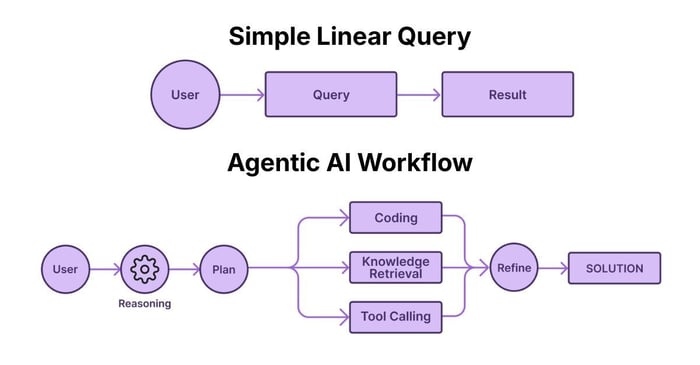
As Salesforce recently noted, “The rise of agentic AI presents a unique infrastructure challenge because its unpredictable, bursting workloads demand a shift from traditional reactive cloud scaling to an intelligent, predictive, and resilient foundation.”
In this new paradigm, static infrastructure fails. The ability for hardware to adapt instantaneously to these bursting workloads — switching between expert models without latency penalties — is no longer a luxury; it is the prerequisite for viable agentic AI. This brings us to the critical bottleneck of modern AI inference: the speed of hot swapping.
To address these challenges with AI Infrastructure, today we are launching configurable model bundles on SambaStack powered by Reconfigurable DataFlow Units (RDU), which deliver significantly faster switching times compared to traditional GPU architectures and inference frameworks like vLLM.

Why vLLM and Traditional GPU Architectures Hit a Wall
The standard approach to serving multiple models on GPUs involves loading models into High Bandwidth Memory (HBM). However, GPU HBM is scarce and expensive. When a workload requires a model that isn't currently loaded, the system must offload the current model and fetch the new one — a process traditionally measured in seconds. Even with vLLM’s Level 1 sleep mode, waking a small model takes between 0.1 and 0.8 seconds. For the large reasoning models required by agents, that wake time creates a latency penalty of 3 to 6 seconds.
For a single user query, a three-second delay is annoying. For an AI agent executing a 10-step chain of thought involving five different models, those delays compound into a 30-second lag. This latency breaks the illusion of intelligence and renders real-time agentic workflows unusable. The GPU architecture, designed for parallel processing of static workloads, simply wasn't built for the volatility of agentic switching.
The RDU Advantage: Three-Tier Memory and True Hot Swapping
SambaNova’s RDU is designed to solve exactly this problem. Unlike GPUs, which are constrained by the HBM capacity on a single card, the SN40L RDU utilizes a unique three-tier memory architecture: on-chip SRAM, massive HBM capacity, and up to 4 TB of DDR memory per rack. The three-tier memory architecture also provides ~10x higher bandwidth between HBM and DDR compared to conventional architectures. By processing AI models using our Dataflow Architecture, hardware bandwidth is fully utilized by naturally eliminating communication and sync overheads that plague other platforms, which results in superior overall performance.
This architecture enables true, hardware-accelerated hot swapping. Because the RDU can access massive pools of DDR memory, it can keep several models “warm” and ready to be used on demand. RDUs don't rely on slow transfers from system RAM over a PCIe bus in the same way a standard GPU server does. Instead, the RDU rapidly reconfigures the Dataflow graph to swap models between DDR and HBM.
This approach creates a "model bundling" capability where a single rack can host a mix of reasoning giants (e.g., DeepSeek or Llama 70B) and specialized lightweight models (e.g., Qwen 32B or Llama 8B), swapping between them to maximize the overall utilization of your AI infrastructure for agentic AI demand.
Data-Driven Performance: Milliseconds vs. Seconds
When we compare the switching speeds head-to-head, the architectural advantage becomes clear. While vLLM’s best-case scenario for a mid-sized model switch hovers around 800 milliseconds, SambaNova’s hot swapping executes the same task in approximately 60 to 90 milliseconds. We are seeing nearly a 10x improvement in switching speed for standard models.
| vLLM GPUs (ms) | SambaStack RDUs (ms) | |
| Small Models (e.g. Llama 8B) | 100 - 800 | 60 - 90 |
| Large Models (e.g. DeepSeek 671B) | 3000- 6000 | 600 - 700 |
Moreover, on GPUs, swapping in a larger parameter model can take several seconds, stalling the agent's workflow especially when planning agentic workloads. On SambaNova’s architecture, even massive bundled models like DeepSeek variants can be hot-swapped in roughly 650 milliseconds.
This sub-second performance across the board means an agent can plan, write code, check its math, and summarize results using four different specialized models in less time than it takes a GPU-based system to load just one of them.
Lowering Total Cost of Ownership of your AI Infrastructure
The implications of efficient hot swapping extend beyond just speed — it fundamentally changes the economics of AI deployment. In a traditional GPU setup, to avoid switching latency, enterprises are forced to over-provision hardware, dedicating specific clusters to specific models (e.g., a "Llama cluster" and a "Mistral cluster"). This results in low utilization and astronomical costs.
Lower TCO
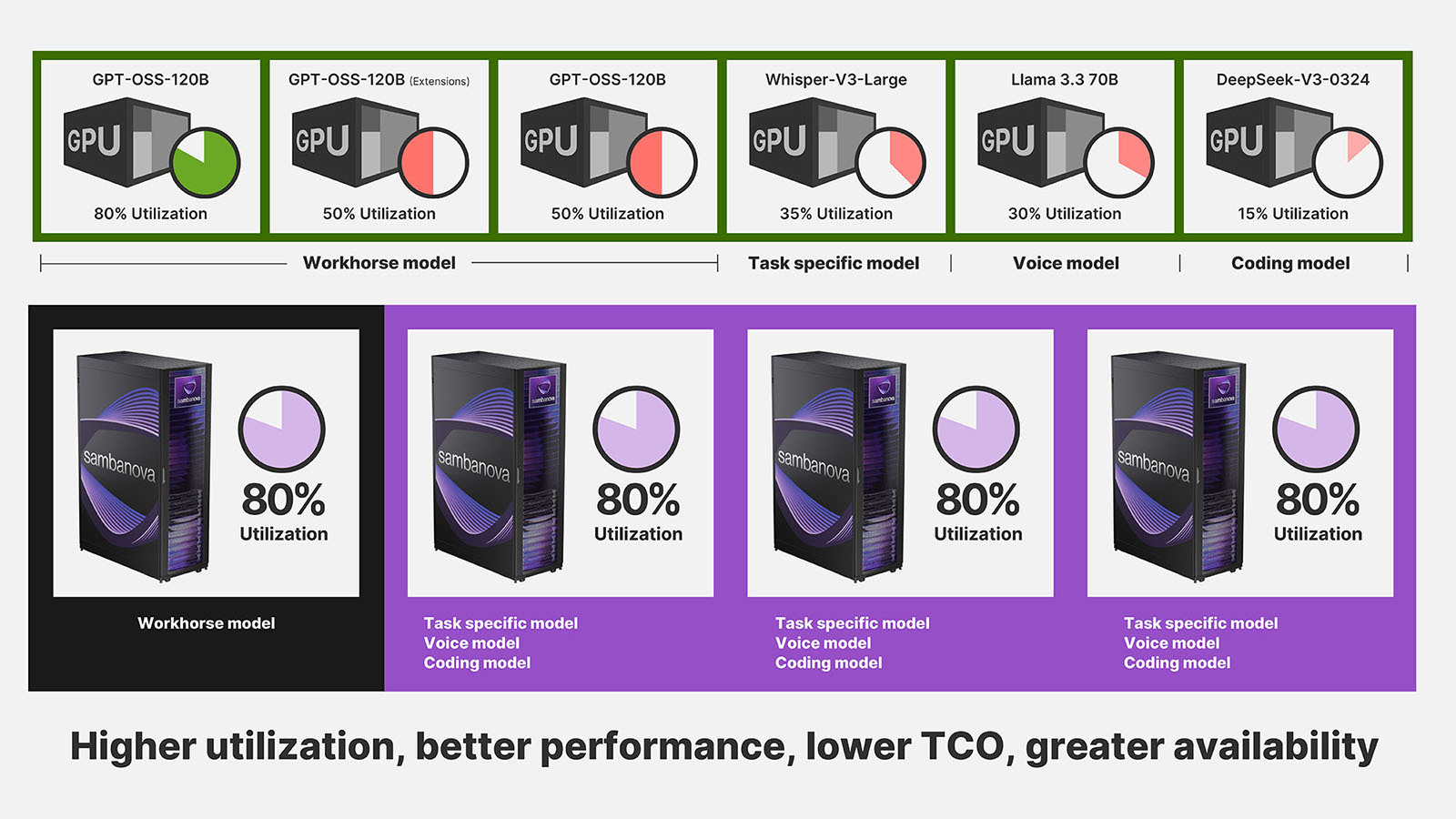
SambaNova’s ability to hot swap allows for multiple tenancy to drive higher utilization. You can consolidate diverse workloads onto SambaRack, utilizing more models with less hardware. For example, a standard four SambaRack cluster will be able to serve what would typically require 6 to 10 GPU racks. In the era of agentic AI, the winner will not be the one with the most GPUs, but the one with the most agile infrastructure.
Build Your Agentic Future Today
The future of AI is agentic, and agents require infrastructure that thinks as fast as they do. Stop letting hardware throttle your innovation. Our teams are laying the foundation for this agentic AI wave with SambaStack. Connect with us today to learn more about how you can leverage SambaNova RDU’s for your existing AI solutions to solve your AI Infrastructure challenges.