

TL;DR
- Training teaches a model statistical patterns from data: capital-intensive, run once on massive GPU clusters over weeks or months.
- Inference applies that frozen model to new inputs in real time to generate predictions.
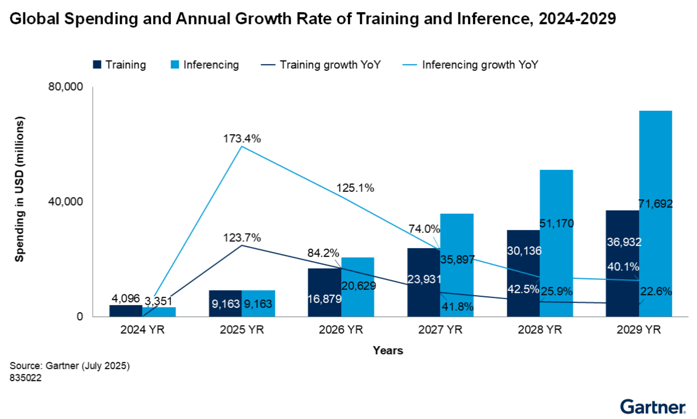
- While training dominated AI investment for years, the economics are shifting as AI moves from experimentation to production.
- Inference will account for 80-90% of a model's total compute costs in production.
- Faster inference lets models "think longer" at query time, producing better outputs without retraining.
Large language model (LLM) development typically has been divided into two distinct phases: the massive, capital-intensive undertaking of training; and the operational utility of inference. For years, the industry’s focus — and investments — was dominated by the race to train larger models on larger datasets.
However, as we move from experimental chatbots to production-grade agents, the economic and technical perspective is shifting. We are entering an era where the value of AI is increasingly derived not just from the static knowledge ingrained during training, but from the compute applied at the moment of query. Understanding the mechanical differences between these phases, particularly the evolving complexity of inference, is critical for developers building the next generation of AI applications.

Deconstructing the Model Lifecycle
To architect efficient AI systems, it is necessary to distinguish between the learning phase and the execution phase.
Training is the process of teaching a model statistical patterns from data. In deep learning, this involves back-propagation and the optimization of model weights over many epochs.
- Pre-Training: This is the heavy lifting — ingesting massive corpora (trillions of tokens) to learn broad representations. It is computationally expensive, requires massive GPU clusters, and runs for weeks or months.
- Post-Training: Once the foundation is built, the model undergoes adaptation via fine-tuning or Reinforcement Learning (e.g., RLHF). While less resource-intensive than pre-training, it is critical for aligning the model with specific tasks or safety guidelines.
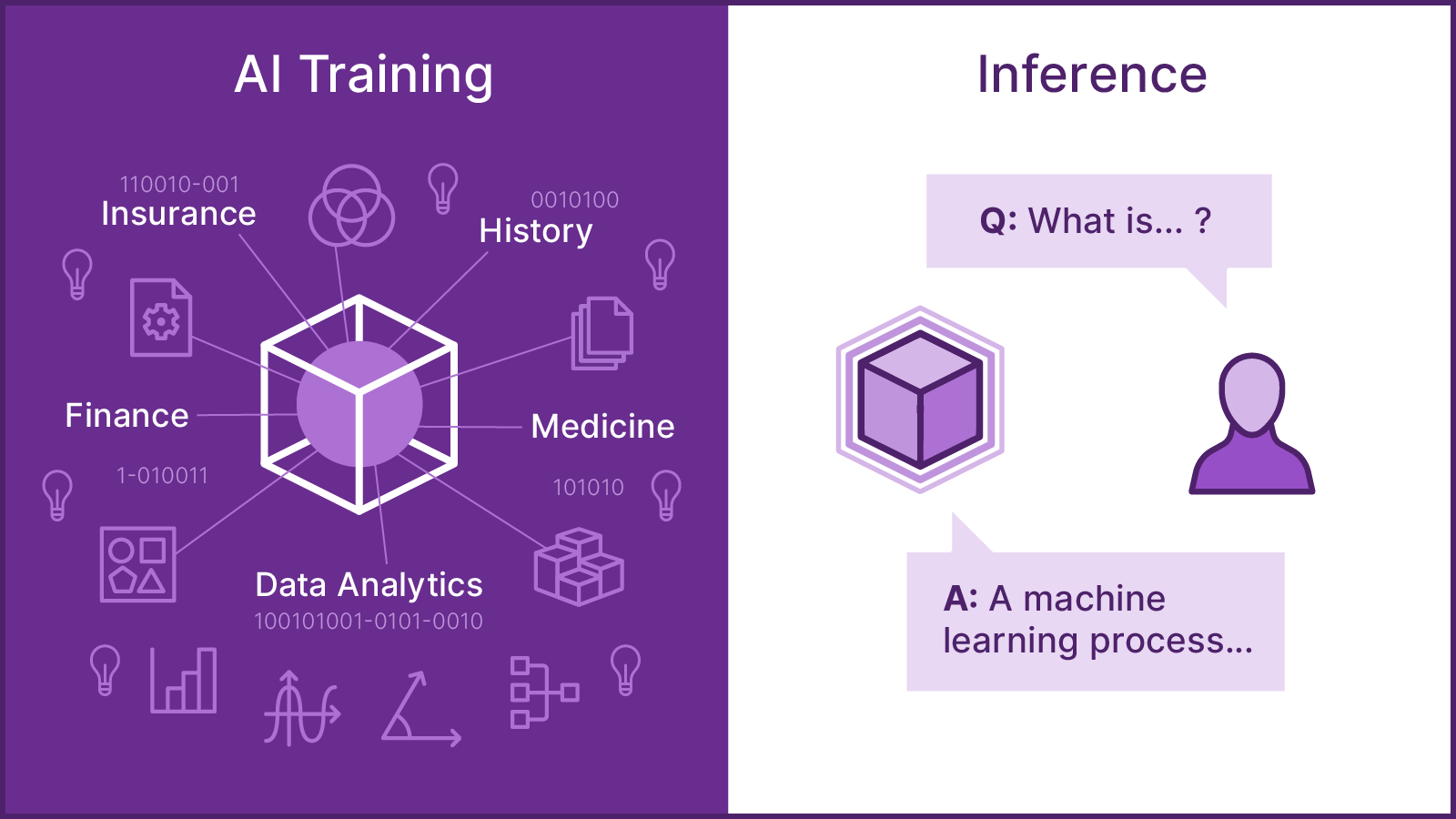
Inference is the application of that frozen model to new, unseen inputs to generate predictions. Unlike the batch-heavy nature of training, inference is often real-time and latency-sensitive. It relies on forward passes to predict the next token in a sequence. As models move into production, the compute spend on inference is estimated to eventually dominate the total cost of ownership, accounting for 80–90% of the model’s lifecycle resources.
The Rise of Test-Time Compute
Pre-training and post-training of AI models are also often referred to as “scaling laws” because they can dramatically improve the accuracy of AI models as you continuously add more data. The third “scaling law” for the AI industry is Test-Time Compute, which refers to giving models more time to think when running inference, which will result in higher accuracy results.
Current research suggests that we are hitting diminishing returns on pre-training scaling. Instead of purely scaling model size, significant performance gains are being realized by allocating more computation during the inference phase. This includes:
- Chain-of-Thought & Reasoning: Allowing the model to generate intermediate reasoning steps (or "thinking tokens") before arriving at a final answer.
- Retrieval-Augmented Generation (RAG): Dynamically fetching relevant context at runtime to ground the model’s responses, rather than relying solely on memorized weights.
- Adaptive Computation: Systems that determine per-query whether a fast, cheap response is sufficient or if a complex, multi-step reasoning path is required.
.jpg?width=1600&height=900&name=2026%2003%2012%20-%20Inference%20at%20Scale%20Blog%20v1.3%20-%2003%20(1).jpg)
All these different techniques can significantly improve the overall cost to performance when using AI models. But when taking these approaches to production, speed and efficiency of inference are vital. By running AI models faster per user, this allows these test-time compute systems to think for longer and generate better results. And inference is not just one monolithic system; it is composed of many different phases and optimizations to get the most out of AI infrastructure.
The Anatomy of Inference: Pre-fill and Decode
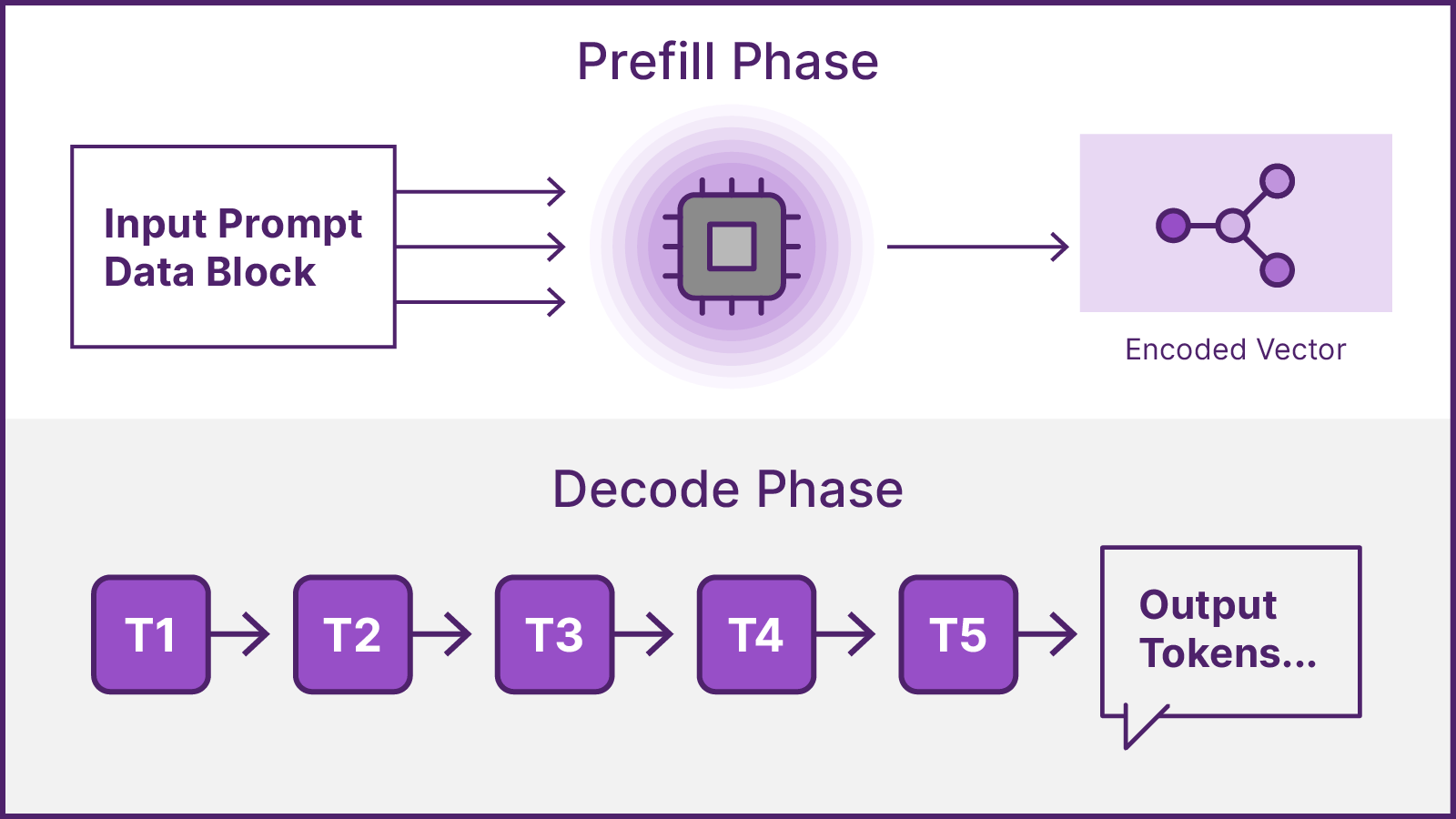
Just like training can be broken into two phases, inference is composed of two distinct phases with opposing computational characteristics: Pre-fill and Decode.
- The Pre-fill Phase (Compute-Bound): When a user sends a prompt, the engine processes all input tokens in parallel to build the Key-Value (KV) cache. Because the attention mechanism has a quadratic cost relative to input length, this phase is highly compute-intensive. The primary performance metric here is Time to First Token (TTFT), meaning the latency between the user hitting "enter" and the first character appearing.
- The Decode Phase (Memory-Bound): Once the pre-fill is complete, the model generates the output one token at a time (auto-regressively). Each new token requires reading the entire model weights and the growing KV cache from memory. Because the arithmetic intensity (math operations per byte of data loaded) is low, this phase is bottlenecked by memory bandwidth, not raw compute. The key metric here is how fast you can produce tokens, in others the Time Per Output Token (TPOT).
These phases are very different from each other in terms of the compute requirements. Today, pre-fill and de-code typically run on the system one after another; however, there are experiments today in having dedicated systems for each phase of the inference process.
While processing inference, the system is not just locked to serving one prompt. With continuous batching, user prompts can be combined together and processed in parallel. This optimization allows systems to achieve higher performance by processing even more tokens. While batch processing improves the overall total tokens processed by a system, it does mean that each individual request will have a lower total user speed. Balancing overall system throughput vs. per user speed will vary from application to application and is often a key requirement for production use cases. With SambaNova’s SambaStack, developers are able to fully configure their systems to optimize for the performance trade-offs they need on their application.
Delivering the Best Inference with SambaNova
The future of AI lies in inference. As the market shifts from experimental training to high-volume, real-time application deployment, the infrastructure must evolve to support Test-Time Compute and agentic workflows efficiently.
SambaNova is purpose-built for this reality. Our platform is powered by the Reconfigurable Dataflow Unit (RDU), a unique architecture designed to crush the memory wall. Unlike clear-cut legacy architectures, the RDU features a three-tiered memory design that keeps data closer to the compute, maximizing efficiency and minimizing latency.
This allows SambaNova to deliver:
- Unmatched Speed: Lightning-fast inference on the largest open-source models, including Llama 70B, DeepSeek 671B, and others.
- Efficiency at Scale: Industry-leading tokens-per-watt performance, enabling data centers to run high-density workloads without spiraling power costs.
- Model Bundling and Hot-Swapping: The ability to run multiple models on a single rack and hot-swap between them in milliseconds — essential for agentic systems that need to switch between specialized models instantly.
Whether through SambaCloud for immediate API access, or SambaStack for dedicated AI infrastructure on-premise deployment, SambaNova provides the high-performance infrastructure necessary to own your AI future.
Ready to experience the next generation of inference? Run the fastest open-source models instantly with SambaNova.