

An AI factory is an end-to-end system that combines data, AI models, compute infrastructure, and governance to train, deploy, and continuously improve AI at scale. As AI moves from experimentation to production, organizations need this kind of structured way to continuously develop, deploy, and optimize AI systems at scale.
TL;DR
- An AI factory is an end-to-end system for building and running AI at scale, covering the full lifecycle from training to inference in one continuously operating environment.
- It turns AI into a production capability with predictable performance, cost, and control.
- AI factories are emerging as AI moves into customer-facing, mission-critical, and agentic AI workloads that demand industrial-grade infrastructure.
- An AI token factory is an AI factory dedicated to inference. Modern token factories pair GPUs for compute-heavy prefill with purpose-built RDUs (reconfigurable dataflow units) for decode, the token-by-token phase users feel.
- They can be cloud-hosted or self-hosted, and are built to run the largest open-source models.
- For neoclouds, sovereign clouds, and inference providers, the token factory is the business: its output is tokens, so tokens per watt, cost to serve, and payback period determine whether it succeeds.
Just as a physical factory mass-produces goods efficiently under strict quality controls, an AI factory runs AI workloads continuously, with predictable performance, costs, and governance.
It includes all the physical and digital infrastructure needed to move AI from experimentation into reliable, trustworthy, and compliant operations at scale.
This article explains why AI factories are emerging, how they work, their architecture and types, and the key considerations when building one for your organization.

From Production AI to AI at Industrial Scale
Running AI in production is not new. What has changed is the scale and consistency now expected of it. Industrializing AI means running every AI system continuously, at scale, and within acceptable cost and risk, the way a factory runs a production line.
For example, consider an internal AI assistant built by a global bank. It runs well in a controlled environment, handling a few thousand queries per day and demonstrating clear productivity gains.
However, requirements change dramatically if the bank wants to take the assistant to users worldwide. The system now needs to:
- Serve millions of customer interactions across regions
- Respond in near real time during peak periods
- Run 24/7 with predictable performance
- Meet strict data residency, security, and audit requirements
- Provide reliable responses even when bank policies and market conditions shift over time
An AI factory gives the bank the environment to achieve this reality.
Why AI Factories Are Emerging Now
AI and machine learning have run in production for years. What has changed is the volume and nature of the work. Generative AI and agents produce their output token by token, so every new user, product, and agent adds directly to the amount of inference an organization has to serve, and to the cost and performance pressure that comes with it.
Today, the competitive edge lies with organizations that can embed AI in customer-facing and mission-critical workflows. Such workloads demand industrial-grade infrastructure and operations.
Performance and cost variability are no longer acceptable
Enterprises need predictable throughput and response times with clear unit economics per AI interaction to scale successfully. Shared cloud resources, ad hoc deployments, and other shortcuts that worked for experimentation do not offer this level of predictability.
AI factories provide infrastructure designed for sustained inference workloads, stabilizing performance and cost.
AI is moving into regulated and high-risk environments
As AI is deployed deeper into core business processes, it increasingly operates in environments governed by:
- Data residency and sovereignty requirements
- Auditability and accountability expectations
- Emerging AI regulations and internal risk frameworks
An AI factory provides the flexibility and control necessary to meet these requirements, including the ability to run sovereign AI entirely within an organization's own borders.
AI continues to evolve at a rapid pace
Accelerated innovation frequently introduces new AI capabilities and optimizations. Enterprises need the ability to continuously evaluate performance and drift, and update or swap models as needed without disrupting production.
AI factories separate model innovation from operational stability. Organizations can evolve models while maintaining a consistent, reliable production environment.
AI has become a core operational capability
AI is no longer confined to data science teams. It is becoming a foundational capability that supports multiple business units simultaneously. This shift requires centralized infrastructure with integrated visibility into performance, costs, and risks.
AI factories provide the technical foundation needed to support AI as a shared, enterprise-wide production capability.
Agents are multiplying demand for tokens
A chatbot sends one request and stops. An agent plans, calls tools, reads results, and loops until the work is done. OpenAI has described a long-horizon Codex agent that ran for roughly 25 hours and consumed about 13 million tokens on a single task. AI factories are built for this kind of sustained, token-heavy demand.
Power has become the constraint
Most existing data centers support 30 kW or less per air-cooled rack, while the latest GPU-based racks draw up to 120 kW and require liquid cooling. That gap means many AI factory projects are gated by power and facility upgrades rather than by chip supply.
How Does an AI Factory Work?
Just as a data center is designed to handle general-purpose computing workloads, an AI factory is designed to handle AI workloads at scale. It operates as a set of interconnected components and processes, with a strong emphasis on performance and efficiency.
Organizations can build an AI factory from scratch using specialized hardware and infrastructure, or use managed services from third-party providers. It can be set up to support the entire AI lifecycle, from training to deployment and inference (running a trained model to generate outputs).
The AI factory model makes it practical for teams to self-host open-source models, integrate with external model APIs, or run both in a consistent operational environment. Rather than treating each model as a bespoke deployment, it provides a standardized production layer for every workload.
Automation is essential for maintaining the reliability and high throughput required for large-scale AI operations. Automated pipelines manage tasks such as tuning, deployment, scaling, and monitoring, reducing manual effort and operational risk. They maintain consistency throughout the AI lifecycle.
When an AI factory is dedicated to inference alone, it is often called an AI token factory.
AI Factory vs. AI Token Factory
An AI token factory is an AI factory dedicated to inference. A full AI factory may train, fine-tune, and serve models, while a token factory does one job: it turns trained models into tokens, continuously and at the lowest cost per token it can.
That changes how it is measured. A token factory is judged on its output: how many tokens it delivers at the speed customers need, how much energy and cost each token takes, and how much of its capacity is sold. Neoclouds, sovereign AI providers, and inference clouds that sell tokens are, in effect, running token factories.
What Is the Architecture of an AI factory?
An AI factory’s architecture is a layered technology stack with two main layers: the compute foundation and the platform layer. This section focuses on the inference side of that stack, the part an AI token factory is built around.
The compute foundation
At its core, an AI factory contains the physical silicon that performs the billions of calculations needed to run AI models. Traditionally, AI factories were predominantly GPU-based. GPUs can perform parallel processing with high performance. This suits model training and prefill, the compute-heavy phase of inference that processes the prompt. Decode, the phase that generates output tokens one at a time, is different: It is limited by how quickly model weights and cached context move through memory.
Conventional accelerators execute a model kernel by kernel, sending data back to off-chip memory between operations. During decode, that repeated movement adds latency and power. Adding more GPUs reduces decode latency only a little, while increasing power draw, networking complexity, and cost to serve.
This is where the reconfigurable data flow unit (RDU) comes in. RDUs don't replace GPUs, they complement them. GPUs remain well-suited to training, fine-tuning, and prefill, while RDUs are purpose-built for decode. Modern AI token factories bring both together through disaggregated inference, an approach that splits the inference workload across the hardware best suited to each stage.
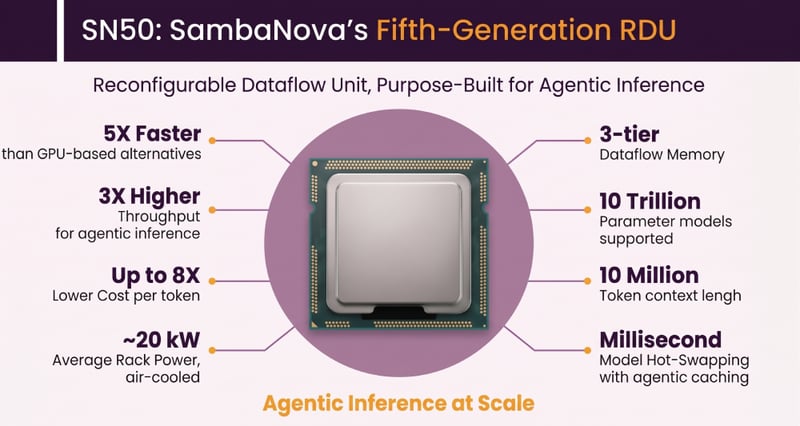
An RDU fuses multiple compute operations into a single kernel call. Through its Dataflow Architecture, data flows from one processing step to the next, without roundtrips to off-chip memory. Its three-tier memory design (on-chip SRAM, HBM, and DDR) delivers high data locality, which significantly accelerates AI model inference. Working alongside GPUs, RDUs add purpose-built decode capacity, so GPUs stay focused on prefill instead of being over-provisioned for every token.
Servers and racks group these processing units with networking, power, and management components to form computing clusters. The goal is to create clusters that can:
- Deliver consistent throughput
- Consume energy efficiently
- Balance workloads across many accelerators
- Integrate into existing data center infrastructure, if needed
The platform layer
The platform layer is software that sits above the compute foundation. It abstracts hardware complexity and provides a unified environment for running, managing, and scaling AI models in production.
For example, it includes software for:
- Managing model lifecycles (loading, versioning, switching, and retiring models)
- Orchestrating inference workloads across available accelerators
- Supporting advanced AI patterns such as multi-model and agentic workflows
- Optimizing performance, latency, and cost at scale
- Providing operational controls for reliability, observability, and governance
Without a strong platform layer, AI infrastructure remains fragmented. Models become tightly coupled to specific hardware, scaling becomes manual, and operational efficiency quickly degrades.
What Are the Types of AI Factories?
AI factories can take several forms, depending on the level of control an organization requires over infrastructure, models, and operations.
Cloud-hosted AI factories
A cloud-hosted AI factory runs on public cloud infrastructure. The organization can connect the factory to its enterprise network and deploy and run models via APIs.
Organizations can choose their factory architecture configurations without having to invest in or maintain any hardware or platform software. Cost is based on usage, and getting started requires only a few code changes.
Self-hosted AI factories
A self-hosted AI factory is deployed in an organization's own data center or a dedicated colocation facility. Both the compute and platform layers are owned and managed by the organization. It is fully controlled, purpose-built, and optimized for the organization's requirements.
Self-hosted AI factories are typically chosen by organizations that:
- Operate under strict security, sovereignty, or compliance requirements
- Need predictable performance and cost at scale
- Want deep customization of infrastructure and AI workflows
The trade-off is operational complexity. Running a private AI factory requires significant expertise, ongoing investment, and disciplined operational practices.
Provider-operated AI token factories
Neoclouds, sovereign AI providers, and inference clouds build AI token factories as their core business and sell the output to developers and enterprises as tokens or dedicated capacity. Examples running on SambaNova include OVHcloud for EU developers and enterprises, Argyll's renewable-powered sovereign inference service in the UK, Infercom in Germany, and SCX AI in Australia.
Key Factors to Consider When Building an AI Factory
When building an AI token factory, or the inference side of a broader AI factory, organizations must ensure it delivers performance, efficiency, flexibility, and resilience at enterprise scale.
GPU infrastructure can be used for model training, fine-tuning, and prefill. To deliver the decode performance users expect at AI factory scale, operators pair it with RDUs. The two are complementary: Through disaggregated inference, GPUs and RDUs work together, each handling the part of the workload it runs best.
Consider the following factors when building for inference.
Speed and throughput
Latency (response speed) and throughput (number of simultaneous responses) are often in tension. Systems optimized for throughput can deliver slower individual responses, while systems optimized for single-user speed may fail to scale economically.
This trade-off matters because modern AI applications, especially agentic workflows, execute multiple reasoning loops, call tools, and interact with several models during a single session.
AI factory infrastructure must therefore support both sustained per-request speed and high aggregate throughput to meet user experience expectations and cost targets.
Predictable latency improves end-user experience while high throughput controls per-unit cost as AI usage scales.
Energy consumption and efficiency
As AI workloads grow, energy usage becomes a major operational and economic factor. Efficiency isn't measured simply by power draw; it must be considered in terms of what work is accomplished per unit of energy.
For AI factories, this translates to the number of tokens or inference operations produced per joule of energy consumed (often expressed as tokens per watt).
Efficient energy use:
- Lowers energy consumption and cooling overheads, reducing operational costs
- Enables deployment in facilities with limited power capacity
- Supports cost predictability in high-volume AI production
It also helps organizations align AI initiatives with broader sustainability goals.
Unit economics and payback
An AI factory that sells capacity is judged on how quickly it earns back its investment. Accelerators, networking, storage, power, and cooling all require funding before the first workload earns revenue, and operating costs continue whether capacity is sold or idle. Cost to serve, billable utilization, and the price customers will pay for speed together set the payback period.
How SambaNova Helps You Build Your AI Token Factory
The SambaNova system is built around the SambaRack™, which integrates 16 RDU chips per rack. It is available in an SN40-16 configuration optimized for low-power inference and an SN50 configuration purpose-built for fast agentic inference on the largest models.
At RAISE Summit 2026, a disaggregated setup with one NVIDIA H200 rack for prefill and one 16-chip SambaRack SN50 for decode ran MiniMax M2.7 at up to 850 tokens per second on short-context workloads and over 450 tokens per second on long-context workloads, as benchmarked by Artificial Analysis.
You can configure SambaRack systems for throughput, latency, or a balanced mix of both. SambaRack systems deliver up to 4x energy savings over GPUs, and SambaRack SN50 averages about 20 kW per rack on air cooling, so it fits most existing air-cooled data centers.
SambaStack™ integrates the platform layer and allows your team to fully configure the workloads you want to run on SambaRack systems.
SambaStack can also orchestrate SambaRack systems alongside your existing GPUs and Kubernetes-based inference platforms, serving the whole fleet behind a single OpenAI-compatible endpoint.
It supports leading open-source models, including MiniMax M3, DeepSeek, Gemma 4 31B, and gpt-oss-120b, and SambaRack SN50 scales to 256 networked accelerators for models up to 10 trillion parameters and context lengths up to 10 million tokens.
For neoclouds, SambaNova pairs SN50 decode with compatible existing GPUs for prefill, with a target six-month return on investment, tested against a 70% billable utilization planning assumption.
SambaCloud™ offers RDU-powered inference on leading open-source models as a managed cloud service with OpenAI-compatible APIs, for teams that want to build without operating physical infrastructure.
Connect with our AI experts to start building your AI token factory today.