

The term "data center" indicates a physical facility that stores servers, networking, and other infrastructure necessary to run IT operations in an organization.
TL;DR
- An AI data center is infrastructure optimized for the compute, storage, networking, and power that AI workloads demand, often an existing facility extended with accelerators rather than a purpose-built one.
- AI splits into two workloads: training, which teaches a model on historical data in dense liquid-cooled clusters, and inference, which runs the trained model in production inside existing air-cooled facilities.
- Most organizations run inference, not training, so being AI-ready means matching accelerators, networking, and cooling to the workload and maximizing tokens per second per watt, not building a new facility.
- GPUs dominate model training, purpose-built Reconfigurable Dataflow Units (RDUs) handle inference more efficiently, and CPUs still run the data pipelines, orchestration, and preprocessing around them.
- SambaNova's SambaRack delivers independently benchmarked fastest inference on large open-source models with up to 4x the energy savings of GPU-based alternatives, running at 10 kW on standard air cooling.
For decades, this traditional CPU-centric data center model supported enterprise workloads. However, AI is fundamentally changing infrastructure requirements. Training and experimenting with large language models (LLMs) demand massive parallel computation, far beyond traditional enterprise workloads.
Running AI systems at scale (AI inference) introduces more challenges. Organizations require infrastructure that can continuously move and process large data volumes while maintaining low latency and predictable performance.
As a result, organizations are extending and transforming their traditional data centers to support AI-native workloads. This article explores key components in an AI data center, who needs them, and the different deployment options available to get started.

Defining ‘AI Data Center’
An AI data center is infrastructure optimized for the compute, storage, networking, and power demands of artificial intelligence (AI) workloads. That can mean a purpose-built facility, but it increasingly means an existing data center extended with the right hardware to run AI efficiently.
At their core, AI data centers pair specialized processors, such as GPUs and Reconfigurable Dataflow Units (RDUs), with high-bandwidth interconnects, fast storage, and a power and cooling profile matched to the workload. Alongside these accelerators, CPUs continue to handle data pipelines, orchestration, and preprocessing. Together they deliver the throughput, low latency, and energy efficiency modern AI systems demand at scale.
Building one from the ground up requires substantial capital and technical resources. But that is not the only path, and for AI inference specifically it is rarely the most efficient one. This article explores the alternatives later.
How Are AI Data Centers Used?
As organizations move from isolated pilots to embedding AI across core operations, compute demand is increasing exponentially. What begins as cloud experimentation often evolves into sustained, high-utilization workloads that demand architectural planning, cost optimization, and long-term infrastructure strategy.
As a result, AI data centers are rapidly becoming strategic infrastructure supporting sovereignty, scalability, risk management, and sustained competitive advantage.
Public Sector
Defense and intelligence agencies require sovereign, high-performance compute environments to support advanced analytics, cyber operations, and autonomous systems. They use AI data centers to support national security, resilience, and technological independence.
Similarly, scientific research institutions and universities rely on AI data centers for applications such as climate modeling, genomics, advanced materials, and language research.
Private Sector
Businesses are tapping into the productivity gains and cost savings potential of AI. Adoption has shifted from testing to full-production deployment in organizations worldwide.
Regulated industries, such as financial services and healthcare, must balance AI innovation with strict compliance, data residency, and auditability requirements.
AI data centers allow them to control sensitive data environments while still deploying advanced analytics, fraud detection, personalized medicine, and predictive risk modeling at scale.
What Makes an AI Data Center Different?
The distinction is not traditional infrastructure versus AI infrastructure; the distinction lies in how the workload is processed. Data centers designed for AI split the workloads into two very different jobs because each places different demands on the facility.
Training is where a model learns from historical data. This is the workload most people picture when they imagine AI infrastructure: Thousands of accelerators packed at extreme density, drawing enormous power, often requiring liquid cooling and specially designed facilities. Training clusters are capital-intensive and concentrated among a handful of frontier labs and large operators.
Inference is where a trained model does its job in production, generating predictions, answers, and actions from new data. This is the workload most organizations actually run that grows continuously as AI, and increasingly agentic AI, moves into core operations. Inference does not require a new class of building. With the right architecture, it can run inside existing data centers, alongside the CPUs that still handle data pipelines, orchestration, and preprocessing.
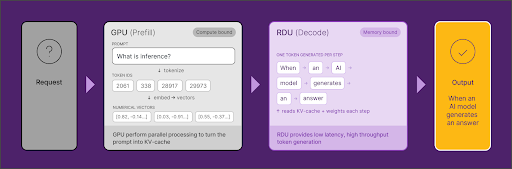
This is where infrastructure strategy comes into play. CPUs remain essential to most AI workloads, but leveraging the right accelerator chip for the right workloads can transform data center performance. By separating the compute-bound prefill workflows with GPUs and memory-bound decode workflows with RDUs, AI data centers can achieve better energy efficiency and better performance without the bottlenecks and latency found with GPU-only implementations.
Making a data center ready for inference at scale comes down to a few requirements:
- Accelerators are sized for inference throughput, not just training, so you maximize tokens per second per watt rather than raw peak compute.
- Networking that moves data between compute nodes at low latency to prevent throughput bottlenecks.
- Storage that feeds model weights fast enough to keep accelerators fully utilized.
- Power and cooling that fit the facility you have. This is the decisive constraint. If inference only ran in liquid-cooled megafacilities, most organizations would be locked out. Architectures that run at low power on standard air cooling bring inference into existing data centers instead.
In short, the goal is not a complete facility overhaul. It is making the infrastructure you already operate ready for sustained inference.
Training Clusters vs. Inference-Ready Data Centers Summary
The table below summarizes how demands differ between the two workloads that shape AI infrastructure.
Core Infrastructure of an AI-Ready Data Center
An AI data center efficiently processes data in the following configuration:
Compute: Accelerators and CPUs
At the heart of any AI-ready data center are specialized processors, known as accelerators, optimized for the matrix and tensor operations required for model training and inference.
They enable massive parallelism and high memory bandwidth, essential for running advanced AI systems.
Different accelerators suit different jobs. GPUs dominate model training, while RDUs are purpose-built for inference. This is the same training-versus-inference split that shapes how the data center facility itself is built.
CPUs
CPUs remain a core part of any AI data center. They run the operating system, coordinate workloads, and handle the data pipeline work that surrounds every model: ingestion, preprocessing, orchestration, and serving requests to and from the accelerators.
In AI infrastructure, CPUs and accelerators are not an either/or choice. The CPU manages the general-purpose work and feeds data to the accelerators, which take on the parallel math of training and inference. A well-designed AI data center balances both rather than replacing one with the other.
GPUs
Originally designed for rendering game graphics, GPUs (graphics processing units) are excellent chips for performing many calculations simultaneously. They are the dominant accelerator for model training, where AI models process historical data to recognize patterns and learn tasks.
From a disaggregated inference perspective, GPUs are well-suited for rapidly processing the highly parallel and compute-intensive nature prefill profile inputs.
RDUs
Once trained, a model is deployed at scale so it can generate predictions from new, unseen data to create economic value and business impact.
This step, called AI inference, is essentially the model operating in the real world, using what it learned during training and newly-acquired data to formulate predictions and drive decisions.
For example, consider an AI security operations agent trained on historical incident data and threat intelligence. Here's what occurs in live operations:
- The agent receives new signals, such as login attempts, endpoint behavior, API calls, or user activity logs.
- The agent then analyzes the data against learned patterns, correlates it with historical behavior, and generates a risk assessment or recommended action.
- Finally, the agent takes action, passing data to other tooling to isolate a compromised device, or sends emails to a human analyst.
Beyond parallel processing a single operation, AI inference requires processing multiple sequential operations at scale.
RDUs are a modern innovation designed to support this. They combine multiple compute operations into a single memory call, so data can flow from one processing step to the next, without memory callbacks. RDUs also have a three-tier memory design for high data locality.
High-speed networking
AI systems require data processing across hundreds or even thousands of servers working together. Hence, fast and reliable networking is essential for moving data between nodes and to other tooling and systems.
Consequently, AI data centers contain low-latency, high-bandwidth networking technologies such as 400 Gbps Ethernet, optical interconnects, and InfiniBand. Without fast networking, bottlenecks slow down training and inference, leading to higher operational costs.
Cooling & Power Considerations
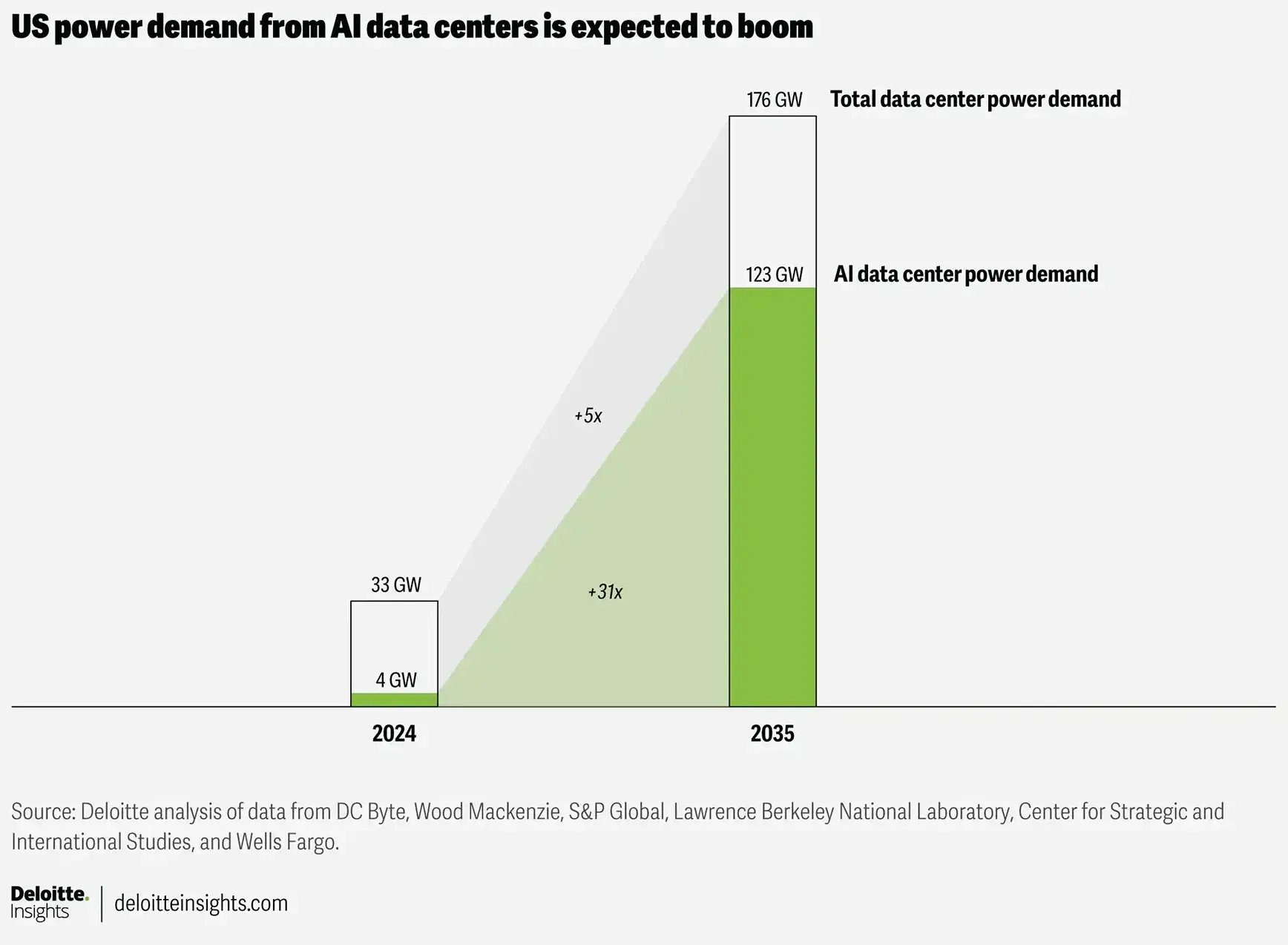
High-performance accelerators consume substantial power and generate more heat than traditional infrastructure.
For cost-efficient inference, an AI data center must balance performance with thermal and energy constraints. It is no longer sufficient to measure total power consumption alone. Organizations must evaluate how much useful AI work is produced per unit of energy.
Accelerator architectures, such as those offered by SambaNova, reduce cooling requirements, lower electricity costs, and enable deployment in facilities with constrained power availability.
Deployment Models: Cloud, On-Premises, and Hybrid AI Infrastructure
Selecting an AI deployment model is a strategic business decision, not simply a technology choice. It shapes cost structure, risk exposure, data governance, scalability, and the organization's long-term ability to innovate.
At a high level, enterprises can choose from three approaches: cloud, on-premises, and hybrid.
Cloud AI Infrastructure
Public cloud providers run and manage their own AI data centers, offering infrastructure as a fully managed service. Organizations can access AI accelerators on-demand, scale capacity instantly, and leverage managed AI services without heavy upfront investment.
For many, this dramatically accelerates experimentation and time-to-value. However, as AI workloads scale, consumption costs can rise quickly.
Data residency, regulatory requirements, and vendor concentration risk must also be factored into executive decision-making.
On-Premises AI Infrastructure
Organizations can build their own AI data centers for maximum control. They retain sovereignty over sensitive data and optimize infrastructure for predictable, high-utilization workloads.
While this model requires significant upfront capital and in-house expertise, it can offer cost stability over time and reduced latency for core internal systems. For regulated industries, the governance benefits often outweigh the initial investment.
Hybrid
Increasingly, enterprises are adopting a hybrid AI model that blends both approaches. Cloud environments are used for rapid development, experimentation, and burst compute needs, while steady-state or sensitive workloads remain on-premises. This approach balances agility with control and optimizes cost across the AI lifecycle.
For executives, the core question is not "cloud or on-premises." It is where different stages of the AI lifecycle, training, inference, data storage, and agentic automation, should reside to align with business risk tolerance, cost efficiency, and growth ambition.
AI Data Center vs. AI Factory: What's the Difference?
An AI factory represents the next stage in the evolution of AI data centers. The term describes an environment in which AI is systematically developed, deployed, monitored, and improved.
An AI data center is one layer of an AI factory, which goes beyond physical infrastructure to processes and systems that industrialize AI.
The shift is from "Can we run AI?" to "Can we reliably convert AI into sustained business impact?"
Architecture
The architecture of an AI data center is hardware-centric. The design challenge is performance, throughput, and reliability under a sustained load.
An AI factory builds on that infrastructure, integrating data ingestion pipelines, deployment frameworks, monitoring systems, governance controls, and feedback mechanisms for continuous monitoring and optimization.
AI data center infrastructure remains essential, but it is one component within a broader, orchestrated system.
Strategy
Strategically, an AI data center represents an investment in capability. It signals that an organization is serious about supporting AI workloads internally and reducing reliance on purely experimental environments.
An AI factory represents an investment in competitive advantage. It embeds AI into core operating processes and aligns models to defined business outcomes, performance metrics, and accountability structures.
The leaders differentiate themselves by transforming their AI data centers into AI factories that deliver business value at scale.
How SambaNova Enables High-Performance AI Data Centers
SambaNova provides SambaRack with 16 RDU chips to introduce specialized AI inference components into your on-premises or hosted AI data center. Independently benchmarked as the fastest inference platform for large open-source models, it delivers high throughput and accuracy on the latest and largest models, with up to 4x the energy savings of GPU-based alternatives.
SambaNova's full-stack SambaManaged solution creates a turnkey SambaRack package to launch sovereign AI data centers in as little as 90 days. With the SN40 RDU, it runs at only 10 kW on standard air cooling, from within your existing data center.
SambaCloud provides AI data center inference components as a fully managed cloud service. It meets ISO 27001:2022 and SOC 2 standards, ensuring compliance with the most stringent requirements.
Ready to Build Your AI Data Center?
Whether you're planning a sovereign, on-premises AI data center or evaluating cloud-based inference, SambaNova can help you get there faster. Talk to our team to see how SambaRack can fit your deployment model.