

AI agents are creating a premium inference business for neoclouds. Coding agents read a repository, generate changes, run tests, and return to the model with the results. As code, tool outputs, and prior turns accumulate, inputs can exceed 100,000 tokens. Artificial Analysis' AA-AgentPerf benchmark replays real coding-agent trajectories with inputs reaching approximately 131,000 tokens per request. Customers need large models that stay responsive as that work grows.
TL;DR
- AI agents are pushing decode into the critical bottleneck for response speed, creating demand for a premium inference tier that neoclouds can price above standard inference.
- SN50 pairs purpose-built decode (RDUs) with compatible existing GPUs for prefill, so providers can add premium inference capacity to the data centers they already run.
- A six-month ROI: Recovering the infrastructure investment through cash generated after operating costs, tested against a 70% billable utilization planning assumption.
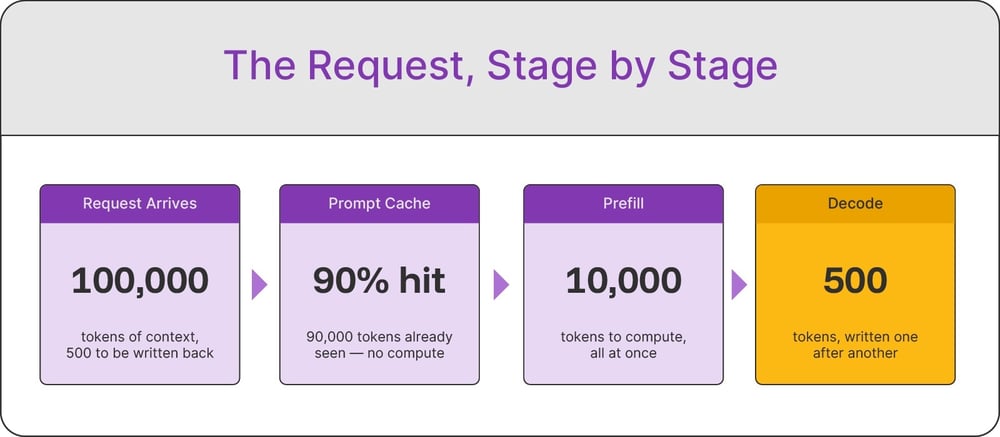
Decode, the stage that generates output tokens, is the bottleneck for sustained response speed. Generation is sequential, each token waits for the one before it, so every millisecond of token latency pushes back the agent's next action. Faster decode helps developers iterate sooner and customer-facing agents move conversations forward without long delays. The processing time offers business value because generation has a significant impact on the workflow's critical path. Customers are paying to accomplish more, sooner, and providers are already advertising fast-serving tiers at higher prices than standard inference.

SambaNova builds for that scenario with the SN50 RDU chip: fast, responsive inference on large models, powered by purpose-built decode alongside GPUs. The goal is a six-month return on investment (ROI) by recovering the upfront infrastructure investment from revenue generated after operating costs. That timeline unifies the commercial and technical goals for neoclouds, from the speed customers pay a premium to the full cost of serving the workloads.
Recover Capital Sooner to Fund Growth
Neoclouds invest in far more than AI accelerators. Networking, storage, power, and cooling all require funding before the first customer workload starts earning revenue. Deployment takes time, demand ramps, and operating costs continue whether capacity is sold or idle. Recovering that investment sooner frees capital for the next expansion and reduces exposure to changing service prices.
Google's September 2026 investor presentation puts AI-server recovery at two years across its blended AI Infrastructure and AI Solutions businesses, excluding TPU system sales. Nebius' Q2 2026 shareholder letter estimates that it will take nearly 2 years to recover capital and related operating costs on new Q2 deals, on a revenue-recognition basis that excludes prepayments and includes capacity not yet built. These company-specific figures are not like-for-like, but they make the priority clear: pair efficient infrastructure with customer contracts that earn back investment sooner.
SambaNova's approach gives neoclouds a way to pursue that return in brownfield data centers: Put SN50's purpose-built decode alongside compatible existing GPUs, and use the site's available power and cooling. The SambaRack SN50 air-cooled design can reduce the facility upgrades needed to add premium inference capacity. The six-month ROI centers on earning more from fast inference while building within the providers' existing infrastructure.
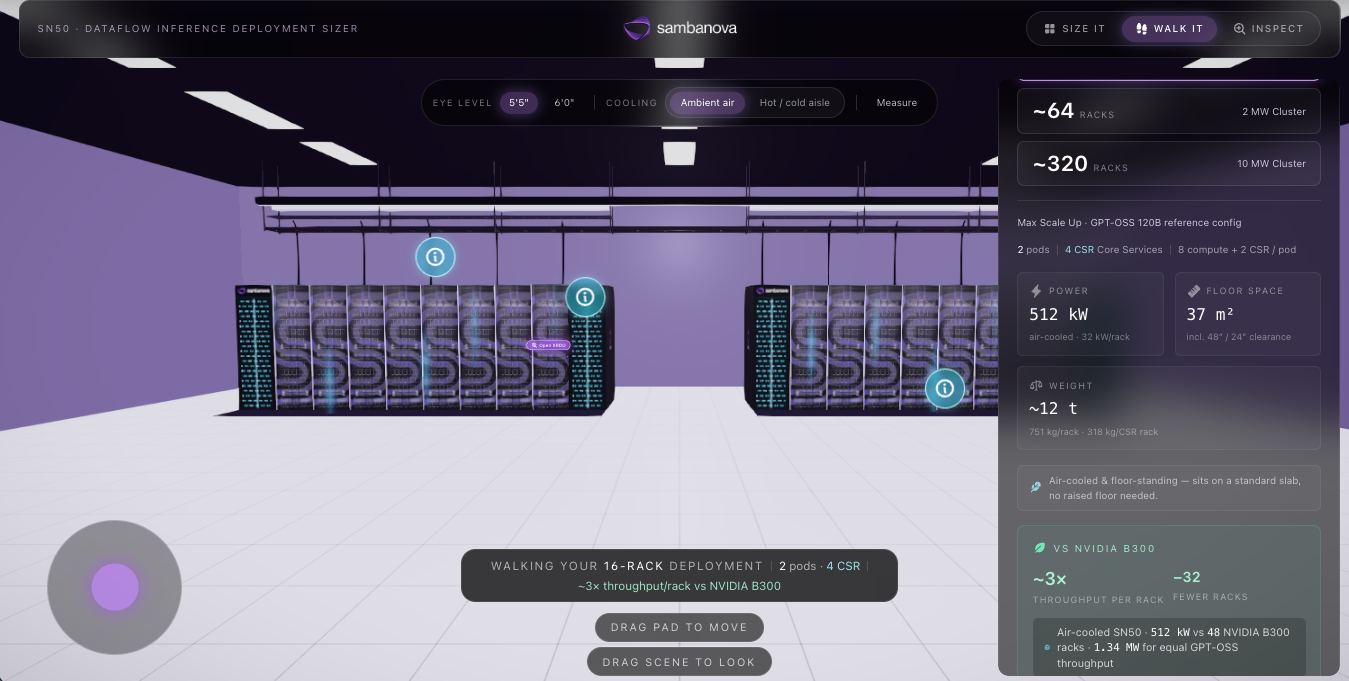
Explore your Data Center Sizing Requirements
How SN50 Turns System Bandwidth into Premium Inference
Prefill and decode are interdependent stages of inference: Prefill processes the input and prepares the KV-cache that decode uses to generate a response, token by token. A responsive service needs both a fast start and fast ongoing generation. Prefill benefits from parallel compute; low-latency decode often depends on how quickly the system moves model data through memory.
SambaNova's disaggregated inference approach puts SN50 reconfigurable dataflow units (RDUs) on decode, paired with GPUs for prefill. Separate hardware pools let providers tune each stage for its workload, reducing competition between long-prompt processing and ongoing generation. The stages still operate as one service, connected by fast transfers of the model's cached state.
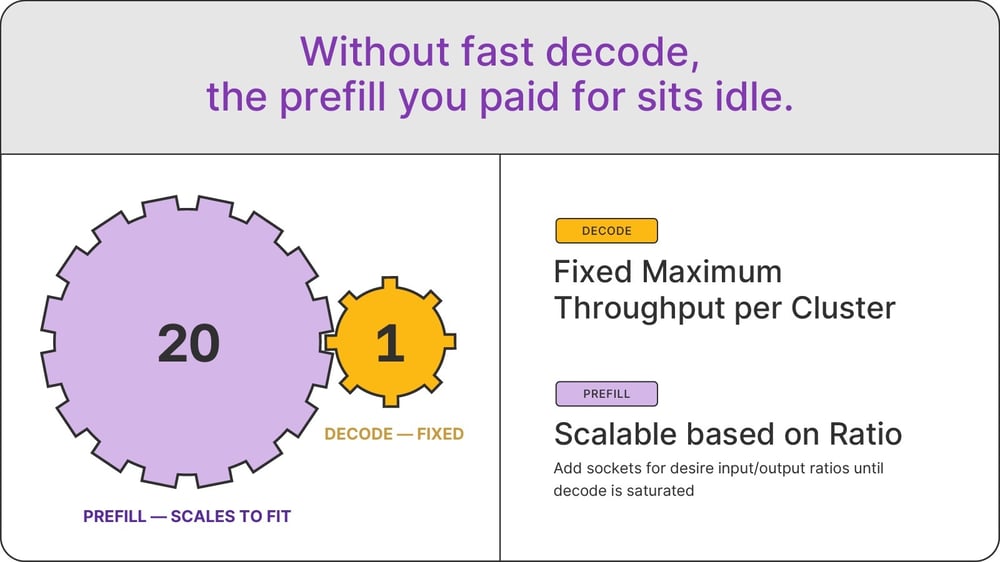
A larger upfront investment can still earn itself back sooner when premium inference generates more cash after serving costs. The opportunity is to turn unmet demand for speed into higher-value traffic, with capacity to grow as customers expand usage. Using 70% billable utilization as an illustrative planning assumption, providers can test the six-month ROI without relying on every available token being sold.
The model and the speed customers expect determine the SN50 RDU cluster needed for decode. GPU prefill adds to the KV-cache completing the request. Reusing cached context reduces how much input must be processed again, which reduces Time to First Token (TTFT). Where existing GPUs are compatible and have enough capacity, they can take on this work, so providers can focus new investment on purpose-built decode and expand prefill as demand requires.
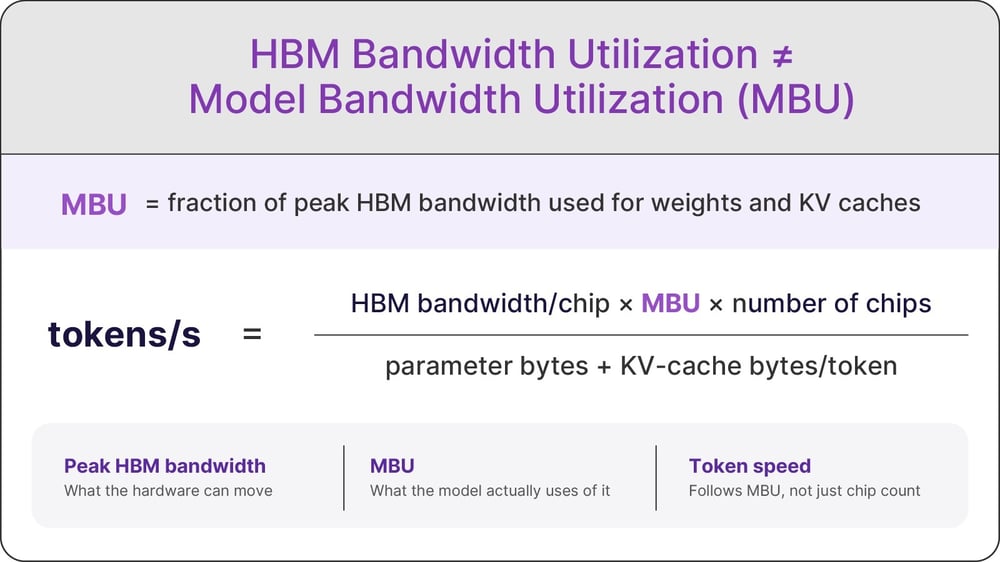
Across the decode cluster, SN50's Dataflow Architecture keeps model data moving through memory, computation, and the network. Large models spread their work across RDUs. This overlapping data movement with computation reduces the time spent waiting within and between chips. That makes more of the system's installed bandwidth useful for generating the fast tokens customers value. SambaNova's Hot Chips 2026 blog post explains the dataflow, memory, and networking mechanisms in depth.
Build a Premium Inference Business that Can Keep Growing
Speed gives neoclouds a service tier that their customers value for accelerating agent workloads. Premium tiers let providers price that productivity advantage. Where existing services cannot meet the speed requirements of interactive and agentic workloads, neoclouds can add faster inference to win additional paying traffic. Providers can tie new capacity to buyer commitments and measure complete workflows at the promised speed, helping turn demand into billable utilization and margin after serving costs.
Neocloud providers investing in SN50 RDUs for decode can use compatible GPUs for prefill. The six-month ROI brings these priorities together: Earn more from the speed customers value and put infrastructure investment to productive use sooner. Get started with SambaNova to plan premium inference around customer workloads, existing infrastructure, and the margins your business needs.