
Fast, secure AI inference for mission-critical government workloads
SambaNova delivers AI inference for America’s federal agencies, laboratories, and research institutions. As a member of the U.S. Department of Energy's Genesis Mission Consortium, SambaNova brings purpose-built RDU infrastructure, full-stack software, and deployment expertise so researchers can run U.S.-developed open models close to mission data.
What the Genesis Mission means for inference →
SambaNova keeps prompts, models, and mission data inside agency-controlled environments, from on-premises labs to fully air-gapped facilities.
Talk to Our Public Sector TeamMission AI is decided at the inference layer
17 National Laboratories

The Genesis Mission connects DOE's 17 National Laboratories with industry and academia across 26 national science and technology challenges.
~1,000 scientists daily

Argonne researchers use coding agents every day for software, proposals, experimental planning, and research workflows.
~200B tokens per month
Argonne's agentic workloads consume about 200 billion tokens a month, and the lab expects that to double.
AI for America’s missions, on infrastructure America controls
The Genesis Mission Consortium connects DOE’s 17 National Laboratories with industry and academia to accelerate discovery in science, strengthen national security, and drive energy innovation.
Genesis is building a national platform that connects America’s supercomputers, experimental facilities, AI systems, and scientific data. Its goal is to double the productivity and impact of U.S. research and development within a decade.
More than peak training compute, the initiative requires secure, low-latency inference that can bring AI into everyday work across code, papers, simulations, proposals, and experimental results.
Inference makes AI usable in mission workflows
The Genesis Mission is building a national platform connecting America's supercomputers, experimental facilities, AI systems, and scientific data. Its goal is to double the productivity and impact of U.S. research and development within a decade.
That goal requires more than peak training compute. Scientists need secure, low-latency inference for agents and models that work across code, papers, simulations, proposals, and experimental results.
SambaNova provides that inference capacity inside U.S.-controlled environments, so supercomputers stay focused on training and the nation's largest simulations.
U.S. mission-critical AI rests on four pillars:
- U.S.-controlled infrastructure
Inference runs on hardware the agency or lab operates, not a third-party model API. - U.S.-developed open models
Agencies choose the models, who can use them, and how they are governed. - Data stays at the mission
Prompts, outputs, and fine-tuned weights never leave the controlled environment. - Complements existing HPC
Dedicated inference sits beside supercomputers, freeing them for simulation and training.
Built for scientists who work with agents
A research agent does more than a chatbot that answers one question and stops. Agentic AI plans, writes code, calls tools, reads results, checks its work, and loops, often across an entire workday. Every millisecond of decode latency is multiplied across that loop. Slow tokens don't delay one reply; they slow down the research itself.
SambaNova's Dataflow Architecture maps the model graph to an efficient path across the reconfigurable dataflow unit (RDU) instead of making repeated trips to off-chip memory. Less memory movement means lower latency and less power for the same work, which keeps coding agents responsive for whole research communities.
Open-model flexibility without external API dependence
Public-sector AI should not require agencies to send sensitive work to an external proprietary model API.
SambaStack™ supports U.S.-developed open models such as OpenAI’s gpt-oss-120b and Meta’s Llama. Exact model availability depends on the deployment, but the platform is designed to give agencies control over where models run, what data they can access, and how the system is governed.
Teams can deploy AI:
- On-premises for full local control
- In dedicated hosted infrastructure for managed but isolated deployment
- In fully disconnected or air-gapped environments for the highest security requirements
All can be served through familiar OpenAI-compatible APIs, helping technical teams integrate AI into existing applications and workflows without rebuilding everything from scratch.




Secure deployment under agency control

SOC 2
Type 2

ISO 27001

Private
Deployment
Data Control

Air-gapped Deployment
Keep prompts, outputs, models, and mission data inside the agency’s or laboratory’s controlled environment. Government teams control the operating environment while retaining the speed and model flexibility needed for production AI.
SambaNova publicly documents its SOC 2 Type 2 and ISO/IEC 27001:2022 certifications. For programs with stricter requirements, SambaStack supports fully disconnected, air-gapped deployments.
- Zero data retention: prompts and completions are not stored or used for training
- No external connectivity required to serve inference
- Models you fine-tune stay yours to run, retire, relocate, or restrict
TACC brings low-latency inference to scientific workflows
At the Texas Advanced Computing Center (TACC), an NSF-funded research center at University of Texas at Austin, researchers run high-performance AI workloads, including coding agents, on SambaStack on-premises.
TACC needed broad support for open-source models and low-latency performance that could keep coding agents responsive for its research community. The air-cooled system fit TACC’s existing data center without specialized cooling.
Using SambaStack’s OpenAI-compatible API, TACC integrated the platform with internal services, including Splunk-based logging, without rewriting its pipelines.
SambaStack provides dedicated inference capacity alongside TACC’s supercomputers for large-scale simulation, modeling, data analysis, and training.
- On-premises deployment
- Air-cooled infrastructure
- OpenAI-compatible integration
- Responsive coding agents
Argonne: Agentic AI for roughly 1,000 scientists
At Argonne National Laboratory, SambaStack SN40 runs on-premises within the Argonne Leadership Computing Facility as part of its Metis system. The deployment provides secure, private access to LLMs and scientific foundation models for roughly 1,000 scientists.
Researchers use coding agents daily for software development, proposals, experimental planning, and research workflows. Those agentic workloads consume about 200 billion tokens per month, and the lab expects usage to double.
This shows what happens when inference becomes a practical scientific instrument: AI moves from isolated experimentation into daily research work.
Proven across the U.S. research ecosystem
SambaNova’s work with Genesis builds on a broader foundation of U.S. national-lab and research deployments.
Argonne National Laboratory (2026)
Agentic coding and research workflows; evaluation of LLMs and scientific foundation models for energy, climate, life sciences, and national security.
Los Alamos National Laboratory (2023)
Generative AI and LLM infrastructure for national security science, technology, engineering, and simulation.
Oak Ridge National Laboratory (2024)
Parallel inference across text and image models for scientific workloads in materials science, climate modeling, neutron science, fusion, and fission.
Lawrence Livermore National Laboratory (2020)
Cognitive simulation that combines HPC with AI for inertial confinement fusion, therapeutics research, and other scientific workloads.
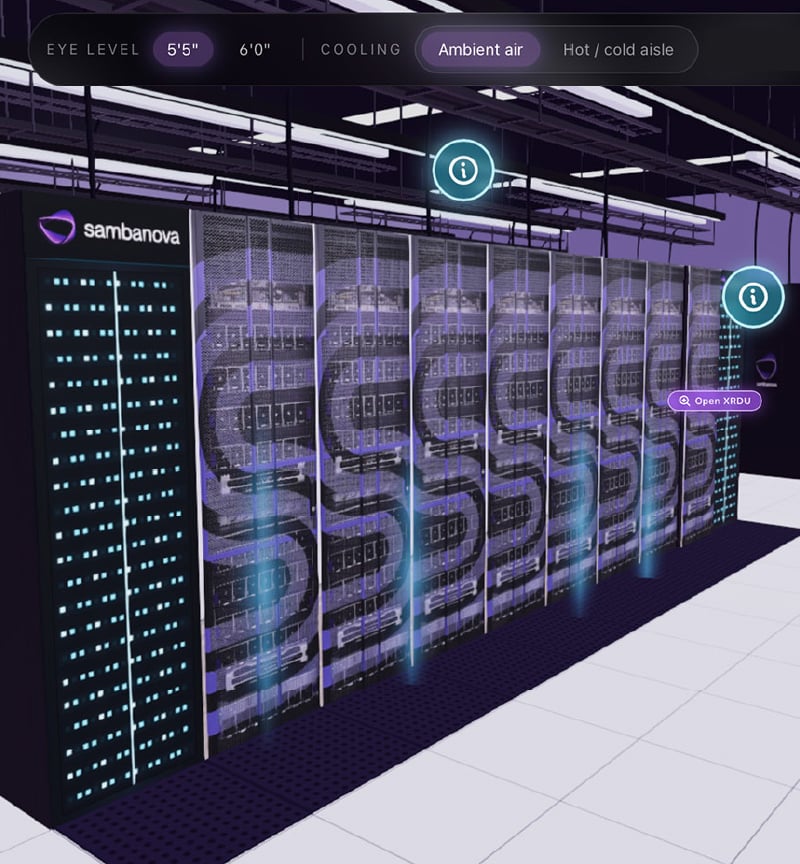
Deploy advanced inference without rebuilding the data center
Public sector organizations cannot always wait for a new facility, a liquid-cooling retrofit, or a major power expansion before putting AI into production.
SambaNova's Dataflow Architecture minimizes memory movement on the RDU, so SambaRack systems run within standard air-cooled power envelopes without a liquid-cooling retrofit, a new build, or a grid upgrade.
Deployment options include:
- On-premises infrastructure
- Dedicated hosted infrastructure
- Air-gapped or fully disconnected environments
The fastest path to mission AI capacity is usually the facility you already operate.
Make AI an everyday instrument for American science
Genesis depends on giving researchers practical access to AI across everyday workflows, while supercomputers remain focused on the largest simulations and training jobs.
SambaNova brings responsive inference to U.S.-controlled infrastructure so agencies and labs can run open and scientific models under their own security and governance.
FAQs
How is SambaNova used in the U.S. public sector?
Why do national labs need dedicated inference if they already have supercomputers?
Supercomputers are built for training and large-scale simulation. Everyday AI use, such as coding agents, literature review, and proposal drafting, runs continuously and needs fast, responsive inference. Dedicated inference capacity keeps those workflows fast without taking supercomputer time away from simulation.
Can SambaNova run in air-gapped or fully disconnected environments?
Yes. SambaStack supports fully disconnected and air-gapped deployments for agencies and laboratories with strict security requirements.
How does SambaNova protect government data?
Prompts, outputs, models, and mission data stay inside the agency's controlled environment. There is no prompt logging, no data retention, and no third-party data sharing. SambaNova holds SOC 2 Type 2 and ISO/IEC 27001:2022 certifications.
How does SambaNova help scientific and research workflows?
SambaNova provides low-latency inference for workloads such as coding assistants, proposal development, literature review, simulation analysis, and agentic research workflows, helping researchers apply AI in everyday work.
What security and compliance credentials does SambaNova provide?
SambaNova publicly documents its SOC 2 Type 2 and ISO/IEC 27001:2022 certifications and supports architectures designed for controlled and disconnected deployment environments.