

AI demand is heating up. Models are getting larger, more capable, and more expensive to serve, and every new release raises expectations for what an AI experience should feel like.
TL;DR
-
Premium inference is fast, responsive serving for large, intelligent models. Agentic AI has turned it into a distinct product tier rather than a nice-to-have.
-
Agent loops multiply latency. OpenAI reported a long-horizon Codex agent running roughly 25 hours and consuming approximately 13 million tokens. Slow decode delays the entire product, not just one response.
-
The market is already pricing speed. MiniMax charges $2.40 per 1 M high-speed output tokens versus $1.20 for standard output tokens. OpenAI, Anthropic, and Fireworks all ship fast tiers at a premium.
-
Delivering premium inference requires disaggregation: GPUs for compute-heavy prefill, SambaNova RDUs for latency-sensitive decode, with a serving layer routing between them.
-
SambaRack SN50 runs MiniMax M2.7 at roughly 820 tokens per second (TPS) for premium interactivity, or roughly 420 TPS when the goal is throughput and concurrency.
-
For inference providers and neoclouds, premium inference is a tier they can price, not a cost they have to absorb.
Agentic AI makes that pressure immediate. A coding agent, research copilot, or enterprise assistant does not just produce one answer and stop. It plans, calls tools, reads context, generates tokens, checks work, and loops until the job is done. When the model is large and the workflow is multi-step, slow output tokens do not just delay an answer — they delay the entire product experience.
That is why premium inference matters. Premium inference is fast, responsive serving for large intelligent models, which is difficult to deliver because providers must balance speed, reliability, throughput, and cost-to-serve when compute capacity is constrained.
Think of it as a premium inference token factory for the agent era. Prompts, context, tool calls, code, documents, and prior turns come in; fast, high-quality output tokens must come out continuously, reliably, and economically. That factory only works when each stage is optimized: GPUs for building context; Reconfigurable Dataflow Units (RDU) for streaming decode; and the serving layer for coordinating the workflow.

The next wave of AI will not be won by the cloud selling the cheapest commodity token. It will be won by neoclouds and inference providers that can serve the best tokens at the right speed tiers. This means premium interactivity for high-value workflows, enough throughput for real demand, and economics that protect margins.
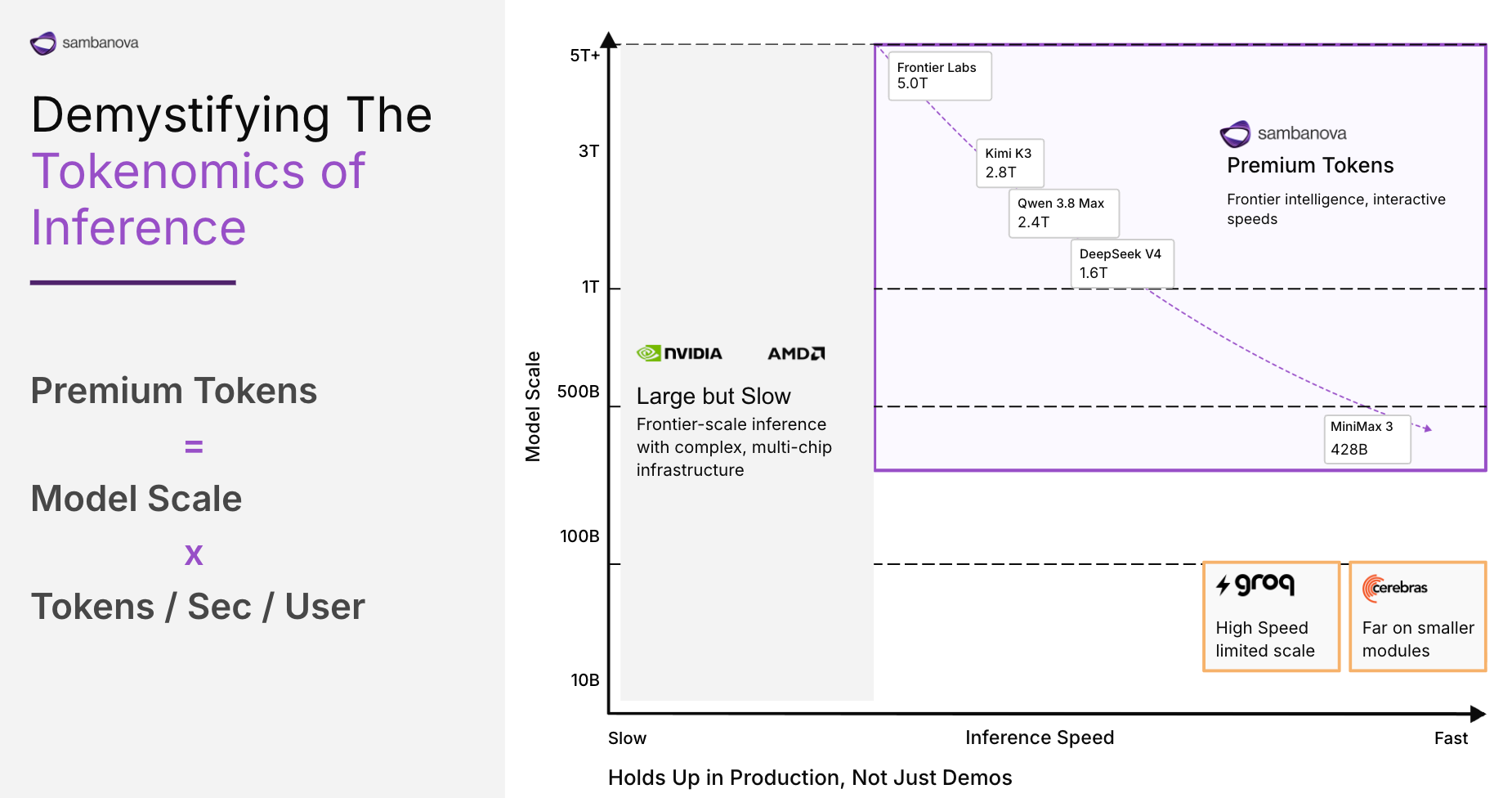
The Demand for Faster Tokens Is Insatiable
Coding Agents Make Latency a Product Problem
Agents, especially coding agents, are the growing use case that highlights the need for premium inference because users feel latency immediately. In a recent blog post on long-horizon Codex agents, OpenAI’s agent ran for roughly 25 hours, used approximately 13 million tokens, and generated about 30,000 lines of code while continuing to verify and repair its work. While an impressive multi-day run, that kind of loop only works as an iterative product if the model is fast.
The Market Is Already Pricing Speed as a Tier
Today, that exact use case is why inference providers are already packaging premium inference. OpenAI’s new Fast mode is designed for high-value, user-facing applications where latency is paramount; on GPT-5.6 Sol, OpenAI says it can deliver up to 2.5X faster speeds than Standard processing at a per-token premium.
Anthropic is packaging a similar need with Claude fast mode. Open-model providers are doing it, too: MiniMax publishes MiniMax-M2.7 and MiniMax-M2.7-highspeed tiers, with high-speed output tokens priced at $2.40 per 1 M versus $1.20 for standard, and Fireworks offers Kimi K3 on a Fast serverless tier for latency-sensitive workloads at +50% over standard. The naming may differ, but the demand is the same: Customers are paying more when faster tokens translate into better experiences.
That is the message for inference providers: Agentic AI is not creating demand for generic tokens. It is creating demand for premium inference, meaning fast, responsive AI that keeps high-value workflows moving.
The Challenge of Delivering Premium Inference
Serving premium inference is difficult because the requirements pull against each other. More capable models improve quality, but they increase memory movement, networking pressure, and serving complexity. Higher concurrency improves business throughput, but it can degrade the per-user experience. Premium inference is a system-level balancing act: Quality, interactivity, throughput, deployment control, and economics must hold together at the same time.
Many serving architectures struggle here because they optimize one dimension at the expense of another. A homogeneous GPU stack is strong for training and compute-heavy prefill, but decode is different. Decode is memory-bound, token-by-token, and increasingly constrained by how efficiently the system can move model weights and KV-cache data. Adding more GPUs can improve latency to a certain extent, but it also increases power, networking complexity, and cost-to-serve. Batch-heavy serving can improve throughput, but it makes user-facing agents feel slower.
This is where SambaNova’s Dataflow Architecture matters. Dataflow is designed around the core problem of inference: moving data efficiently. Instead of forcing repeated, redundant trips to off-chip memory, the RDU maps the model graph to an efficient path across the processor, so data can move with lower latency and better power efficiency. For decode-heavy agent workloads, that is how fast tokens become a practical service tier rather than an expensive exception.
That is what separates a commodity endpoint from a differentiated AI service. Providers are not just selling access to a model, they are selling an AI experience customers value enough to pay more for premium tiers to unlock higher productivity. More importantly, neoclouds don’t need to replace their hardware completely in order to serve premium tokens. The practical path is hybrid:
-
Use GPUs where they are strongest
-
Use RDUs where decode becomes the bottleneck
-
Tune the serving layer so premium speed becomes a product tier, not a compute constraint
The Architecture that Makes Premium Inference Practical
That hybrid architecture starts by separating the inference pipeline, an approach known as disaggregated inference. In a real agent workflow, context comes in, tokens stream out, and the serving layer coordinates tools, queues, and state around the model. Each stage has a different bottleneck, so each stage should run on the architecture built for it.
Prefill is compute-heavy. It turns prompts, retrieves documents, code, files, tool outputs, and prior turns into the model’s KV cache. GPUs are a strong fit because this stage is highly parallel.
Decode is latency-sensitive. It generates the answer token by token, where memory movement and per-token latency become the bottleneck. SambaNova RDUs are purpose-built for this phase, which most users feel the most impact.
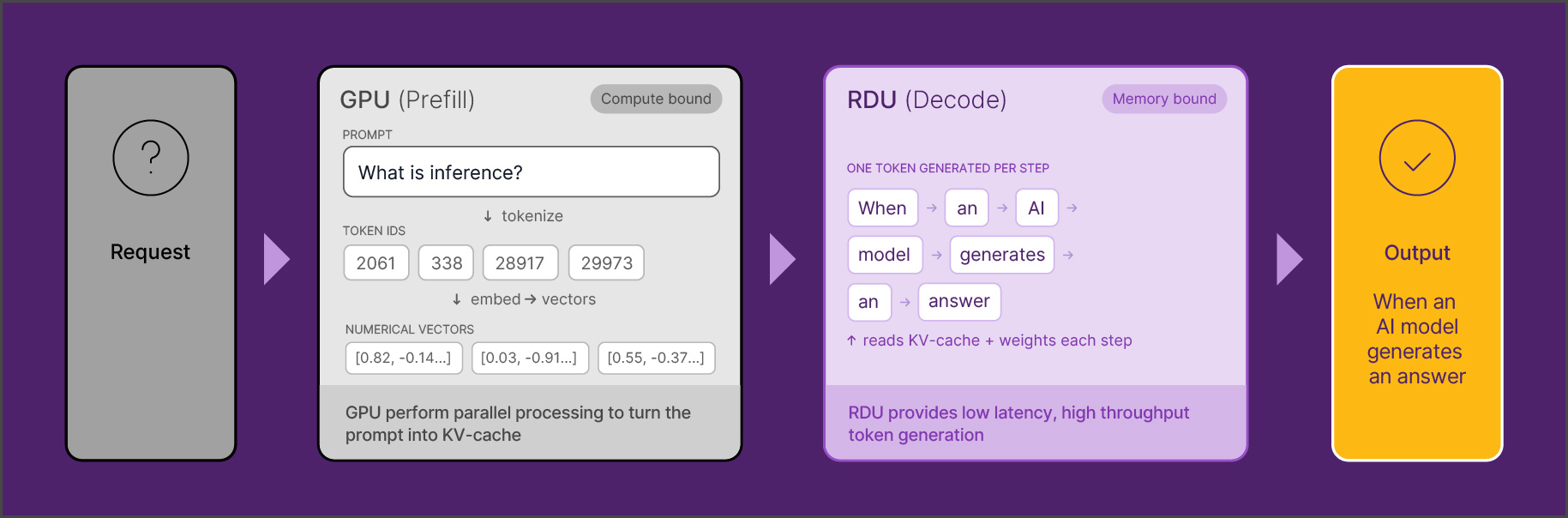
The more agent traffic is optimized for prompt caching, the clearer this split becomes. OpenAI’s prompt-caching guidance notes that repeated prefixes can reduce time-to-first-token latency by up to 80% and input-token costs by up to 90%. OpenAI’s GPT-5.6 efficiency post also describes agent loops sending the same instructions, conversation history, tool definitions, and earlier results multiple times within a single turn. As those repeated prefixes are reused, the heavy prefill work becomes more efficient, and decode, the token-by-token phase every user feels, becomes the bottleneck the fleet has to keep up with.
That is why the hybrid architecture is about improving utilization across the whole inference fleet. GPUs stay focused on prefill and other compute-heavy work instead of being over-provisioned for every token-generation path. RDUs add purpose-built decode capacity where output tokens are generated. The serving layer routes work across those resources based on cache state, context length, user tier, and latency target, so providers can deliver premium speed without stranding capacity or burning margin.
SN50 Makes Premium-Tier Economics Tangible
Two Serving Configurations, Two Business Outcomes
That is where SambaRack SN50 turns the premium inference idea into something providers can price and operate. In the SemiAnalysis benchmark, MiniMax M2.7 runs on two SN50 serving configurations. One pushes interactivity to the ~820 TPS range for the fastest user-facing experiences. The other runs around ~420 TPS while creating more room for throughput and concurrency. Read the full SemiAnalysis benchmark post here.
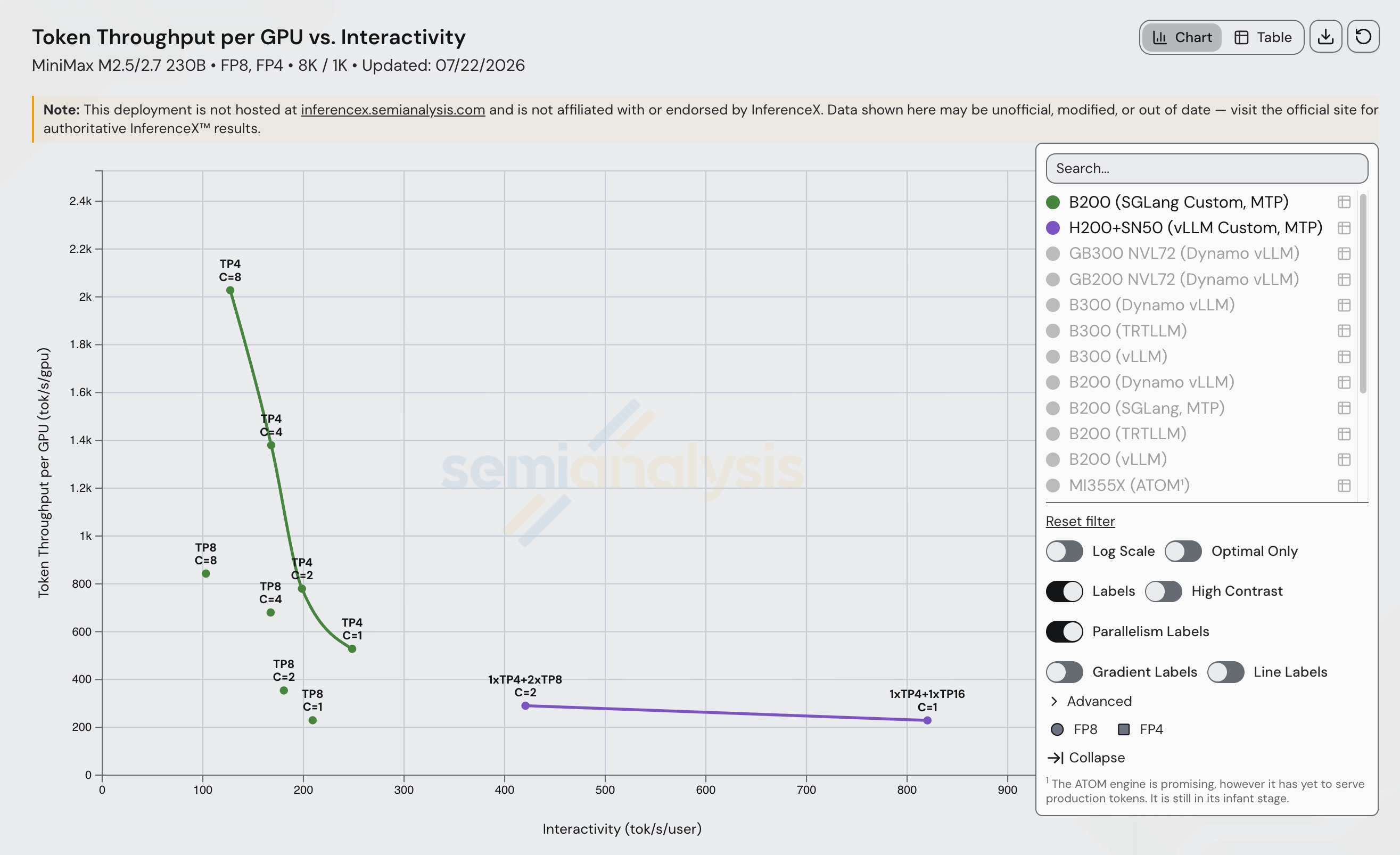
What It Means for Cost-to-Serve
That split matters because the market is already assigning value to speed. MiniMax prices regular output tokens at $1.20 per 1 M tokens and high-speed output tokens at $2.40 per 1 M tokens. In other words: Faster tokens are not just a better benchmark. They are a product tier.
Then the provider question becomes simple: Can you serve that tier fast enough for users, broadly enough for demand, and efficiently enough for the margin to work? SN50 gives providers a clearer tuning knob. Use the fastest configuration when the workflow needs premium interactivity. Use the higher-throughput configuration when the goal is serving more concurrent demand.
The Takeaway: Demand Is Here for Premium Inference
Agentic AI has created the demand for a new tier of inference servicing. While the need for standard commodity inference will continue to exist on GPUs for many chatbot like applications, the market for Premium inference for agents will continue to grow rapidly. SambaNova SN50s are built to help solve this bottleneck and designed to work interoperably with the GPU ecosystem. The premium inference moment is here. Providers ready to serve premium inference will be the ones who profit the most from it. If you are scaling agent workloads and want premium inference without premium cost pressure, let’s talk.