

Sovereign artificial intelligence (AI) is more than simply enabling AI capabilities in a region. Governments are facing difficult questions about reliance on foreign cloud platforms and shared global models. Sensitive public sector data may sit outside national control. Compute resources may run in other jurisdictions. Security and policy decisions may depend on private companies in different legal systems.
These concerns are why sovereign AI matters. Nations want direct control of infrastructure, models, and data. They want to protect critical systems under their own laws. They want the ability to decide how AI behaves and what rules govern its use.
The need for autonomy becomes urgent when national security, civic services, and public trust are involved.

With fewer regional cloud providers available, organizations and governments are many times dependent on AI data center resources outside their own borders. The growing importance of AI and digital sovereignty highlights the need for a distributed, hybrid architecture that offers economic return and sovereignty.
Some countries have begun to see sovereign AI as a pillar of resilience and independence. They recognize that national competitiveness depends on more than access to advanced models: It depends on where data resides, how workloads run, and who sets the performance and governance conditions.
As more and more countries establish their own AI clouds, platforms, and data centers, we are entering a new phase of AI development where digital autonomy is part of the national identity.
What Is Sovereign AI?
Sovereign AI is running AI on your own terms, under your own laws, and on infrastructure you control. This is the simplest definition of sovereign AI in practice.[1]
Of course, the 'you' in this definition refers to governments, organizations, or even regional entities that seek to maintain control over AI development and deployment within their own jurisdictions.
Sovereign AI enables governments and regions to protect sensitive data and critical infrastructure, one of the primary motivations for sovereign AI adoption. It gives nations control over how models behave, how data is stored and used, and how AI interacts with public and private services. For example, EU data residency rules require keeping many workloads on sovereign infrastructure, and Canada’s federal cloud strategy similarly prioritizes locality of sensitive workloads.
Many countries now view sovereign AI as a key component of national strategy and security.
The Rise of Sovereign AI Ecosystems and Local Infrastructure
This shift is impacting who leads in the AI era. Instead of a small group of global platforms, there is now a wider set of players. Each group is building its own sovereign AI infrastructure that resonates with regional culture, creating national AI models and local development teams.
For instance, France and Germany have launched trusted cloud initiatives, and the UAE’s G42 Cloud program supports sovereign AI capacity. This freedom creates a more diverse and resilient global AI landscape where no single region defines what AI should look like or how AI should function.
How Are Governments Accelerating Sovereign AI and Cloud Initiatives?
Across Europe, Asia-Pacific, the Middle East, and Latin America, governments are announcing sovereign AI or sovereign cloud programs, such as Gaia-X in Europe, onshore AI efforts in Australia, and Brazil’s national AI cloud investments to reduce their reliance on foreign tech giants.
Many of these initiatives pair national strategies with concrete investments in local or regional data centers, high-performance compute, and both closed and open-source models that adhere to strict data residency and governance rules. Analysts have begun describing this as a clear move from centralized AI to a distributed network of sovereign AI ecosystems.[2]
These programs go beyond control and open the door to new AI hubs that support local needs and niche strengths. A sovereign AI data center in one region can focus on classified defense workloads under strict confidentiality laws. Another can focus on health research in the local language.
Which Companies Already Power Sovereign AI Ecosystems?
For instance, SambaNova powers the AI inference cloud for partners, some of whom prioritize sustainable power efficiency and local resource development, like Argyll in the UK.
Other SambaNova partners, such as SouthernCrossAI in Australia, deliver AI that is hosted onshore and compliant with national values. In the EU, Infercom and OVHcloud power sustainable regional AI hubs focused on data security and regulatory adherence for high-speed generative AI.[3]
Key considerations for implementing a sovereign AI data center include:
-
How quickly the data center become operational?
-
What are the high-speed performance demands?
-
What are the operational costs for power and cooling?
-
How easy is it to scale for future growth?
These operational realities shape how sovereign AI systems are designed. A region cannot wait years for infrastructure to come online or accept runaway energy costs for inference workloads, especially when the goal is independence from foreign providers.
Sovereign AI Infrastructure Is Also an Economic Story
When countries invest in domestic AI infrastructure, they are creating demand for local data centers, hardware integration, software platforms, and security services. Startups, mid-size firms, and research labs that build on a sovereign AI stack all benefit from this arrangement. European leaders consider sovereign AI a way to strengthen competitiveness and keep more digital value within the region, which is better than exporting it through pure consumption of foreign services.[4]
This shift from AI consumer to producer status also affects the talent pipeline. If sovereign data centers cannot sustain high-speed workloads or operate within reasonable power budgets, the long-term economics and competitiveness of sovereign AI will weaken, regardless of policy motivations. Sovereign AI projects require engineers, product teams, compliance experts, and policymakers with deep AI literacy.
When those roles sit inside the country, they develop skills and advance regional values domestically. Over time, those teams can produce exportable innovations: models tuned for regional languages, tools adapted for local sectors, and governance frameworks that other countries may want to adopt. That is how sovereign AI turns into a flywheel for economic empowerment, not just a defensive shield.
Key Requirements for Sovereign AI Infrastructure
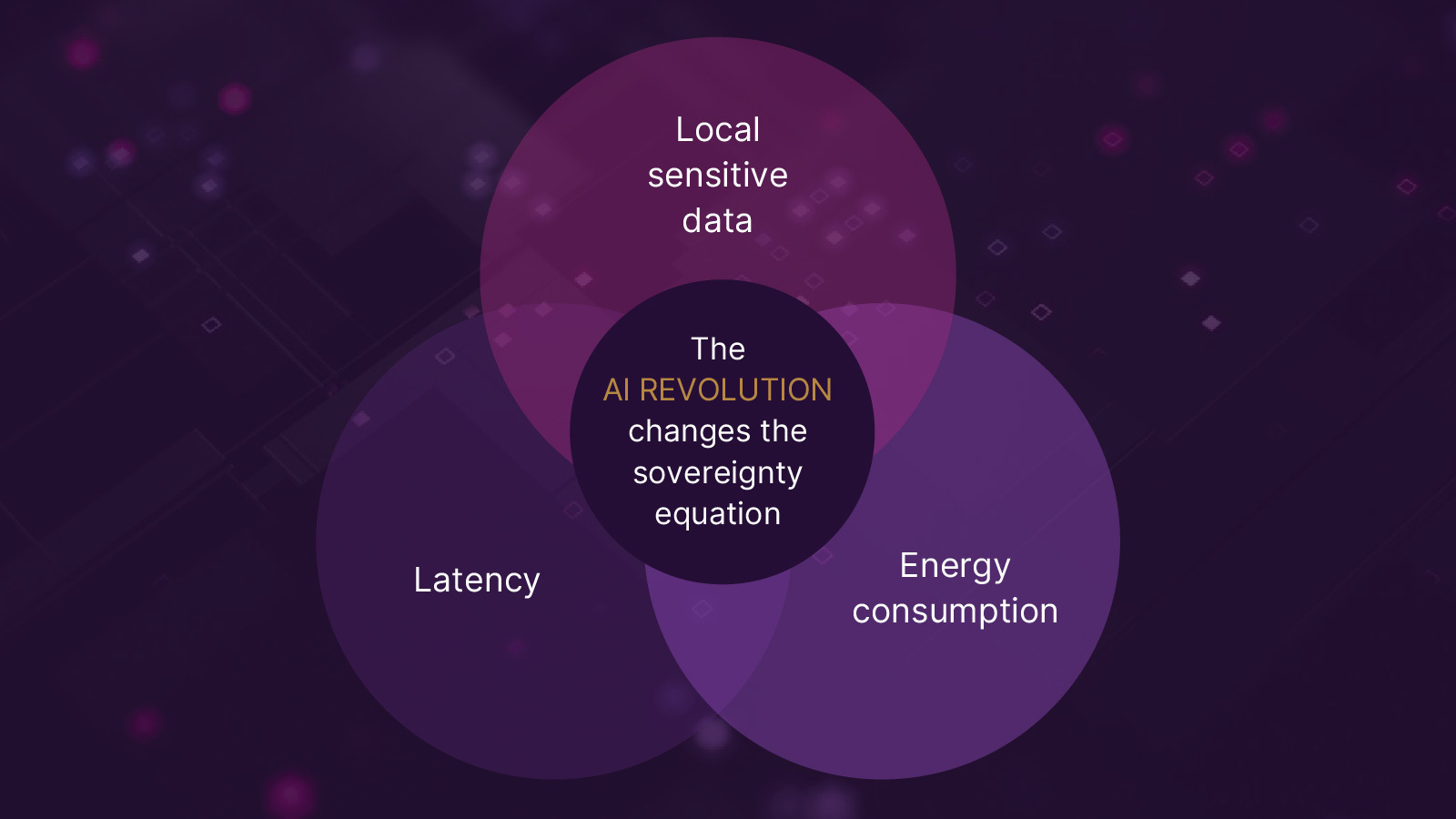
Sovereign AI demands infrastructure that supports local data handling, high-performance compute, strict governance, and low-latency workloads. Many regions also need systems tuned to local languages, local compliance rules, and local industries.
Technological Innovation – What Lies Ahead?
Sovereign AI propels the underlying technology to better support local requirements and constraints, rather than advancing technology for its own sake. Once you take language, culture, and sectoral nuance into consideration, the models and infrastructure need to match those characteristics.
Large models must support numerous local languages, dialects, and scripts. Domain-specific models are required for industries such as energy, finance, or healthcare under local regulation. Even large language models (LLMs) are able to run more efficiently on the SambaNova platform as seen by running the fastest DeepSeek model in the world.
How Does Sovereign AI Accelerate System and Hardware Innovation?
Sovereign AI drives efficiency, performance, and compliance forward together rather than separately. These pressures accelerate innovation in system design, where improvements in model throughput, batch efficiency, and thermal performance translate directly into lower operational costs for sovereign AI workloads.
Hardware innovation follows the same pattern. Sovereign AI pushes providers to design more energy-efficient chips and systems because many regions face power constraints, strict environmental rules, or cost pressures.
Data center architectures must handle high-intensity AI workloads without wasting energy or water. Additionally, storage and networking stacks must support local residency and security rules without slowing down real AI workloads. Sovereign AI becomes a forcing function that encourages more thoughtful, efficient, and region-aware AI infrastructure.[8]
A New Era of AI Autonomy and Cooperation
All of these signals point to a major shift. Sovereign AI moves us from a world where a few global platforms set the tone to one where many countries participate in shaping the future of artificial intelligence for the local citizens. They can decide how their data is used, how their models behave, and how their infrastructure grows to best suit the needs of their population.
-
Sovereign AI depends on balancing autonomy with practical execution:
-
Systems must come online within predictable timeframes.
-
Data centers must meet power and cooling limits.
-
Local workloads must reach high-performance targets.
-
Capacity must expand without dependence on foreign compute.
At the same time, sovereignty does not remove responsibility. Nations that build sovereign AI capabilities also bear an obligation to cooperate on issues such as AI safety, cross-border risks, and global scalability.
Sovereign AI is redefining who leads and who benefits from artificial intelligence. By developing AI on their own terms, nations fuel innovation at home and contribute to a more inclusive, collaboratively governed global AI landscape.

How SambaNova Powers Sovereign AI for Nations and Enterprises
SambaManaged is a turnkey AI platform – powered by the SN40L RDU chip – that allows regions to build their own advanced AI inference clouds entirely in local data centers.
SambaNova’s full‑stack SambaManaged solution enables the launch of sovereign AI data centers in as little as 90 days. The plug‑and‑play nature of SambaRack accelerates the deployment to deliver world‑class inference performance at only 10 kW and standard air cooling.
This approach respects strict data residency rules, regional compliance requirements, cultural standards, and high-performance workloads without relying on external clouds.
Through collaborations with partners such as Argyll, SouthernCrossAI, Infercom, and OVHcloud, SambaNova shows how sovereign AI data centers can operate at scale with complete control.
FAQs
-
What are the key principles of sovereign AI?
The key principles of sovereign artificial intelligence are local control and culture, transparent rules, and alignment with national laws. - Who are the key players in sovereign AI?
Governments, regional cloud providers, regulated industries, and full-stack AI vendors are among the key players shaping sovereign AI. - Does sovereign AI cost money?
Yes, sovereign AI requires investments in regional compute and governance systems. - What are the risks of sovereign AI?
There are some inherent risks associated with establishing sovereign AI protocols, such as cost, technical complexity, talent pool, and the risk of isolation if regions avoid collaboration.
However, sovereign AI also offers significant benefits, including
- Enhanced data privacy and security
- Regulatory compliance
- Local innovation
- Stronger national security and economic independence
-
How does sovereign AI benefit regions?
Sovereign AI supports public health, climate programs, safety systems, and education under strict ethical rules.
References
[1] - https://sambanova.ai/solutions/sovereign-ai
[2] - https://stlpartners.com/articles/data-centres/sovereign-ai
[5] - https://gaia-x.eu/what-is-gaia-x
[6] - https://artificialintelligenceact.eu/high-level-summary/
[7] - https://oecd.ai/en/ai-principles
[8] - https://www.ddn.com/blog/why-sovereign-ai-demands-a-rethink-of-data-infrastructure