
Frontier Coding, 1M Context, and Native Multimodality. Build Long-Horizon Agents on SambaCloud
TL;DR
- MiniMax M3 runs fastest on SambaCloud, where it is available today for developers building long-horizon, long-context agents.
- On coding and agent benchmarks, MiniMax M3 scores 59.0% on SWE-Bench Pro, 66.0% on Terminal-Bench 2.1, and 74.2% on MCP Atlas, making it one of the strongest open-weight models available.
- MiniMax M3 introduces MiniMax Sparse Attention (MSA), delivering a 1M-token context window with more than 9x faster prefill and more than 15x faster decoding than the previous generation.
- In MiniMax's internal testing, MiniMax M3 ran autonomously for roughly 24 hours to optimize an FP8 GEMM CUDA kernel, lifting hardware peak utilization from 7.6% to 71.3%, a 9.4x speedup, with zero human intervention.
- MiniMax M3 is natively multimodal, trained on text, image, and video from step 0, so it can read charts, formulas, and screenshots and operate a desktop computer.
MiniMax M3 is the successor to MiniMax M2.7 and their most capable model to date. It is built for long-horizon agent workflows, complex software engineering, and multimodal tasks that were previously the exclusive territory of closed-source frontier models. It hits 59.0% on SWE-Bench Pro, 66.0% on Terminal-Bench 2.1, and 74.2% on MCP Atlas, making it one of the strongest open-weight options available for coding and agent harnesses.
Read the full MiniMax M3 announcement here.
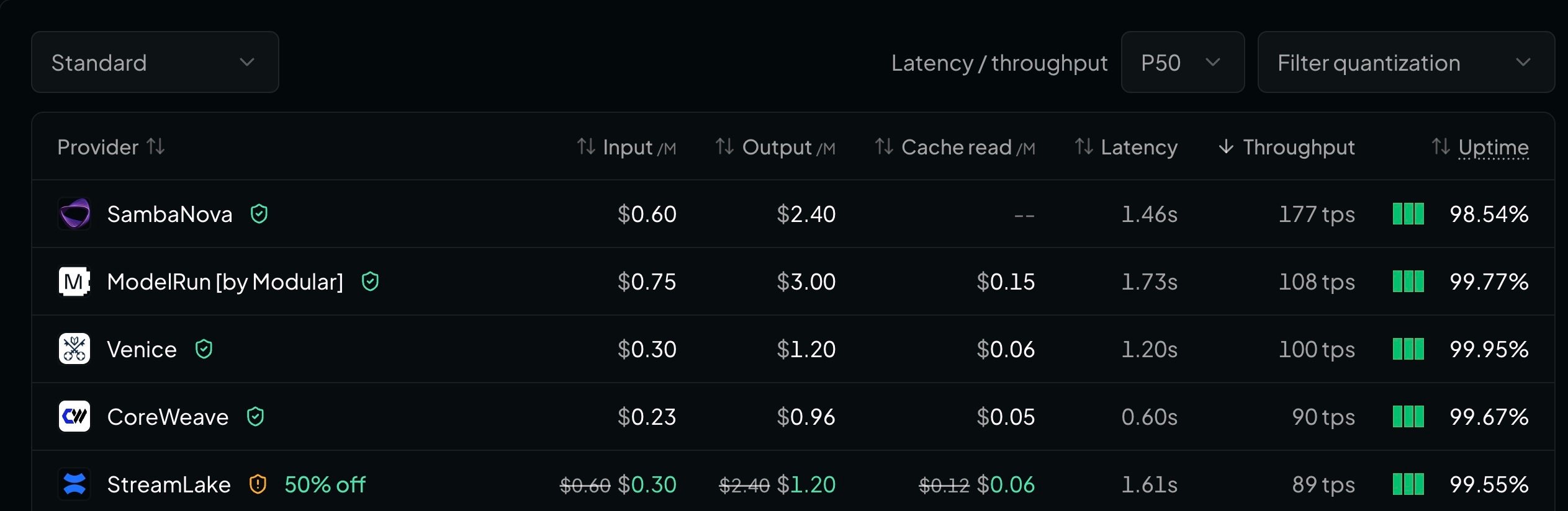
MiniMax M3 (M3) is the latest frontier model from MiniMax and it's running fastest on SambaCloud.
Note: If you are using MiniMax M2.7, please migrate over to MiniMax M3 immediately.

Why Use MiniMax M3?
MiniMax M3 marks a generational leap from the M2 series, becoming the first and only open-weight model to unify capabilities that were previously table stakes only for closed-source frontier models. Key upgrades include:
1M-Token Context via MSA
M3 introduces MiniMax Sparse Attention (MSA), a new attention architecture that makes context a truly scalable dimension. At 1M-token context, per-token compute drops to 1/20th of the previous generation, with more than 9× faster prefill and more than 15× faster decoding — while matching full attention on the vast majority of capabilities. Entire repositories, papers, and multi-day agent logs now fit in a single context window.
Frontier Software Engineering
Production-grade performance across SWE-Bench Pro (59.0%), Terminal-Bench 2.1 (66.0%), SWE-fficiency (34.8%), and KernelBench Hard (28.8%). MiniMax trained M3 with an interactive user simulator that mirrors how real developers collaborate — clarifying requirements, adjusting solutions, and iterating across multiple rounds — so the model works as an active collaborator, not just a passive instruction-follower.
Long-Horizon Autonomy
In MiniMax's internal testing, M3 ran autonomously for ~24 hours optimizing an FP8 GEMM CUDA kernel — 147 benchmark submissions and 1,959 tool calls — lifting hardware peak utilization from 7.6% to 71.3% (a 9.4× speedup) with zero human intervention. It also independently reproduced an ICLR 2025 Outstanding Paper's core experiments over a ~12-hour run, producing 18 commits and 23 experimental figures.
Native Multimodality
M3 was trained on mixed text, image, and video data from step 0 — not bolted on afterward. It understands charts, formulas, and screenshots, and can operate a desktop computer, unlocking computer-use agents and end-to-end workflows across applications, files, and systems.
Agentic Office & Professional Work
Strong results on real-world office workflows including search, Office-suite tasks, and tool orchestration (74.2% on MCP Atlas), with emerging capability in financial-domain workflows.
MiniMax M3 competes with the top closed-source frontier models on demanding coding and agentic tasks — while remaining open-weight and dramatically more cost-efficient. For teams running long-horizon, long-context agent workflows in production, M3 sits firmly in the most attractive cost-to-intelligence quadrant available today.
Get Started Quickly with SambaCloud
With just a few lines of Python, you can call MiniMax M3 to analyze an entire codebase, plan a fix, and iterate on its own solution — the same long-horizon loop it uses to autonomously optimize kernels and reproduce research papers.
Check out SambaCloud and explore MiniMax M3 in the playground, or generate an API key and integrate it into your agentic application today.
MiniMax M3 brings frontier coding, 1M context, and native multimodality to production. SambaNova delivers it the fastest.