

SambaNova is launching support for the Responses API across the SambaNova platform — SambaCloud, SambaStack, and SambaManaged — giving AI engineers a cleaner way to connect modern coding agents to fast, production-ready models. /v1/responses support starts with gpt-oss-120b, MiniMax M2.5, and MiniMax M2.7.
TL;DR
- SambaNova's Responses API (/v1/responses) is now live across SambaCloud, SambaStack, and SambaManaged.
- Unlike Chat Completions, it's built for agentic workflows: tool calls, streaming events, multi-step loops, and reasoning-aware pipelines.
- Codex CLI, Cline, and OpenCode all support the Responses API shape and can connect to SambaNova directly.
- The recommended pattern is planner/executor: a high-reasoning model for planning, MiniMax M2.7 for fast, high-volume execution.
- Teams can run an all-SambaNova stack (DeepSeek-V3.1 as planner, MiniMax M2.7 as executor) under a single API key and billing relationship.
This matters because coding agents are becoming tool-using systems, not just chat interfaces. They read files, call tools, apply patches, run tests, inspect errors, and iterate until the work is done. The Responses API is built for that loop.

For developers using Codex CLI, Cline, OpenCode or custom harnesses, the outcome is simple: Use a Responses-compatible interface for agent workflows, then route high-volume coding execution to fast SambaNova-hosted models.
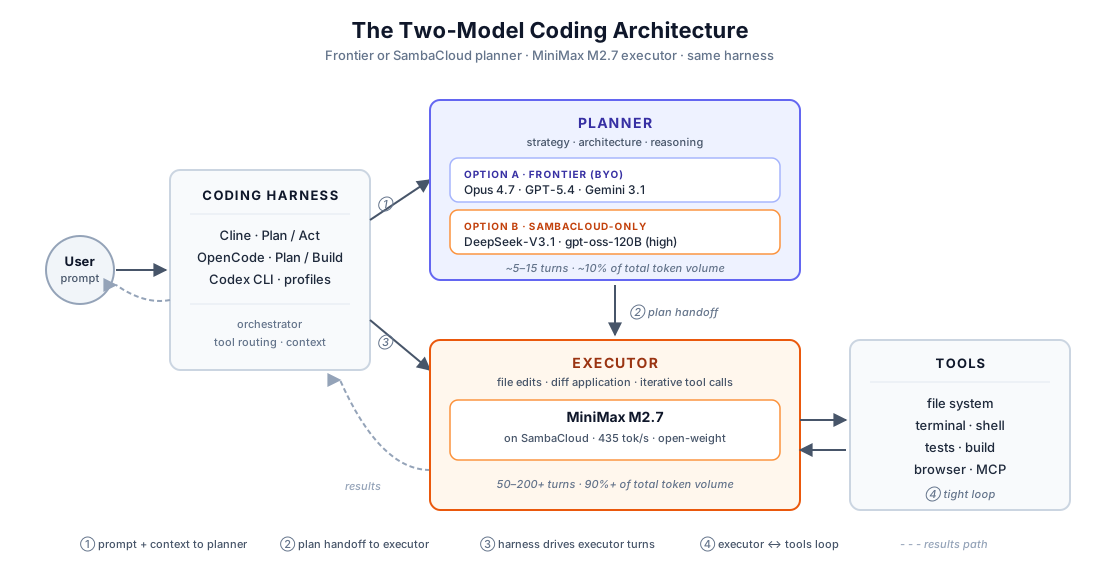
Responses API: What It Is and Why It Matters
Chat Completions was built for conversation. It organizes the interaction as a sequence of messages: a user asks, the model responds, and the client keeps appending messages over time. That works well for chatbots and simple generation tasks.
Coding agents need more structure. They do not just answer; they act. A coding agent may inspect files, call tools, receive tool results, stream progress, update a plan, run tests, and continue from the result of those tests.
The Responses API is designed for those agent workflows. It gives the harness a cleaner way to manage:
- Structured inputs and outputs
- Tool calls and tool results
- Streaming events and intermediate progress
- Reasoning-aware workflows
- Multi-step execution loops
The advantage for AI engineers is less glue code and a cleaner provider interface. If your harness expects Responses, you can point it at SambaNova and use SambaNova-hosted models in the same workflow.
This is especially important for Codex CLI, where provider compatibility depends on the Responses API shape. With SambaNova support for /v1/responses, Codex and other Responses-aware tools can connect to SambaNova models more naturally.
Quick Win: Use MiniMax M2.7 for Coding Execution
MiniMax M2.7 is already live on SambaCloud, and it is the fastest way to see why Responses support matters for coding agents.
The quick win is execution. Once a harness can call SambaNova through /v1/responses, developers can route implementation-heavy turns to MiniMax M2.7: opening files, applying diffs, running tests, parsing failures, and making small fixes. These are the parts of an agent run where speed, cost, and tool-call reliability matter most.
MiniMax M2.7 Speed Comparison
That makes MiniMax M2.7 a strong fit for coding workflows such as refactors, migration tasks, test-failure loops, code review follow-ups, and repo-scale cleanup. The Responses API provides the agent interface; MiniMax M2.7 provides the fast execution layer.
For more detail on why MiniMax M2.7 is strong for coding and agent execution, read our MiniMax M2.7 blog.
From Responses Support to the Planner / Executor Pattern
Once a coding harness can speak Responses to SambaNova, the next question is how to route the work. The answer is not always to run every turn on the same model.
Coding-agent work naturally splits into two phases: planning and execution.
Planning is where the agent reads the repository, understands constraints, identifies risk, and decides what should happen. These are fewer, higher-value turns where reasoning quality matters most.
Execution is where the agent opens files, applies diffs, runs tests, parses failures, makes small fixes, and repeats. These turns are much more numerous, tool-heavy, and latency-sensitive.
That creates a practical planner / executor pattern:
- Planner: Use a frontier model for high-level reasoning, architecture, migration strategy, and risk assessment.
- Executor: Use MiniMax M2.7 on SambaCloud for fast, high-volume coding execution.
The key is not to use a smaller model everywhere. It is to put the strongest reasoning where it matters, then use a fast execution model for the long tail of implementation work.
Two Ways to Assemble the Stack
Teams can choose the setup that fits their quality, cost, and operating requirements.
| Option A - Frontier planner | Option B - SambaCloud-only | |
|---|---|---|
| Planner model | Claude Opus 4.7 · GPT-5.5 · Gemini 3.1 | DeepSeek-V3.1 · gpt-oss-120B (high) |
| Why pick it | Top-of-leaderboard plan quality, especially for novel architectural decisions | Single API key, single bill, fully open-weight, deployable in your own VPC |
| Trade-off | Two vendors, two keys, two contracts | Slightly behind frontier on the very hardest reasoning tasks |
| Speed on SambaCloud | n/a (external) | DeepSeek-V3.1 ~250 t/s · gpt-oss-120b (high) ~669 t/s (Artificial Analysis) |
Both options use the same core idea: Keep planning high quality, then route the bulk of tool-heavy execution to MiniMax M2.7.
DeepSeek-V3.1 is a particularly strong fit for Option B: It is a 671B-parameter reasoning model built for coding, reasoning, and math. Pair it with the M2.7 executor and teams get a stack that stays inside SambaNova — useful for compliance, simpler operations, and lower end-to-end latency because both models sit behind the same platform boundary.
How the Split Saves Money
Token volume in real coding-agent runs is usually skewed toward execution. A typical run might include:
- Planning: 5–15 dense turns to understand the codebase, identify risk, and create the plan.
- Execution: 50–200+ turns of file reads, edits, test runs, failures, retries, and summaries.
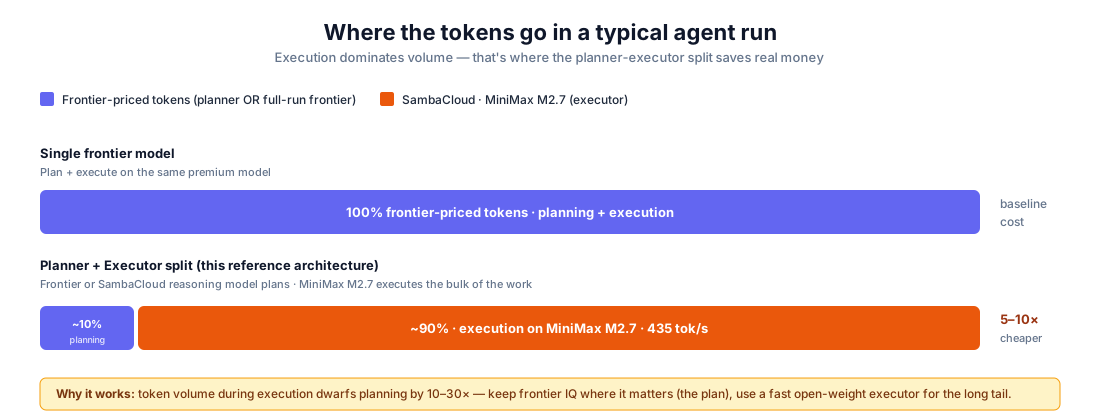
If the entire loop runs on a frontier model, teams pay frontier prices for every execution token — even when the model is mostly doing file I/O, patch application, and test iteration.
The planner/executor split keeps frontier-class reasoning on the highest-value planning turns, then shifts the highest-volume work to a fast, RDU-accelerated execution model. The result is lower blended cost, higher throughput, and a workflow that feels faster because execution latency drops where agents spend most of their time.
Coding Use Cases and Harness Examples
Responses API support is useful anywhere a coding agent needs to move beyond one-shot generation. Codex CLI is the clearest example because it is built around a Responses-style provider interface: adding a new provider is not just about model quality, the provider also needs to support the API shape Codex expects.
With SambaNova support for /v1/responses, developers can configure SambaNova as a Responses provider and route execution work to MiniMax M2.7. The same pattern applies across Cline, OpenCode, and custom harnesses: Plan with the model best-suited for reasoning, execute with MiniMax M2.7 on SambaCloud, and review with the planner when the work needs a final risk check.
Good starting points include:
- Repository refactors that require many file edits
- Test-failure loops where the agent runs, reads, fixes, and retries
- Migrations across APIs, frameworks, or services
- Bug triage that combines code search, logs, and patch generation
- Code review follow-ups where an agent applies reviewer feedback
- Documentation updates that need to stay aligned with code changes
- Agentic development workflows in Codex CLI, Cline, OpenCode, and custom harnesses
In each case, the goal is the same: Keep planning high quality, make execution fast, and use a Responses-compatible interface so the harness can manage tool calls cleanly.
Below are three ways to show that pattern in practice.
1. Codex CLI: Responses API Native
Configure SambaNova as a provider, point it at the SambaNova base URL, and set the wire API to responses.
Then use your planner of choice for strategy and the SambaNova execution profile for implementation-heavy turns.
Codex CLI Demo
2. Cline: Plan / Act Mode
Cline supports separate Plan and Act models, which maps cleanly to the planner / executor pattern.
In Cline settings:
- Toggle “Use different models for Plan and Act modes.”
- Plan mode, Option A: Select Anthropic, OpenAI, or Google and choose the frontier planner you prefer.
- Plan mode, Option B: Select SambaNova and choose DeepSeek-V3.1 or gpt-oss-120B.
- Act mode: Select SambaNova and choose MiniMax M2.7.
- Add SAMBANOVA_API_KEY, plus the frontier provider key if using Option A.
- Cline preserves planning context when switching into Act mode, so MiniMax M2.7 can continue from the plan instead of starting from scratch.
Cline Plan / Act Demo
3. OpenCode: Plan / Build Agents
OpenCode ships with separate plan and build agents. Configure SambaNova as an OpenAI Responses-compatible provider, then assign the planning agent and build agent separately.
Authenticate with OpenCode auth login, choose the SambaNova provider, and paste your SambaNova API key. Then use plan for strategy and build for execution.
OpenCode Plan / Build Demo
The Takeaway
The Responses API launch makes SambaNova easier to use with the next generation of coding agents.
For AI engineers, the value is practical: Connect Responses-aware tools to SambaNova, use strong models for planning, and use MiniMax M2.7 for fast execution where coding agents spend most of their time.
That is the bigger shift. Agent development is moving from single-model chat to multi-model workflows, where frontier reasoning and fast execution work together. SambaNova is making that pattern easier to build, test, and scale.